
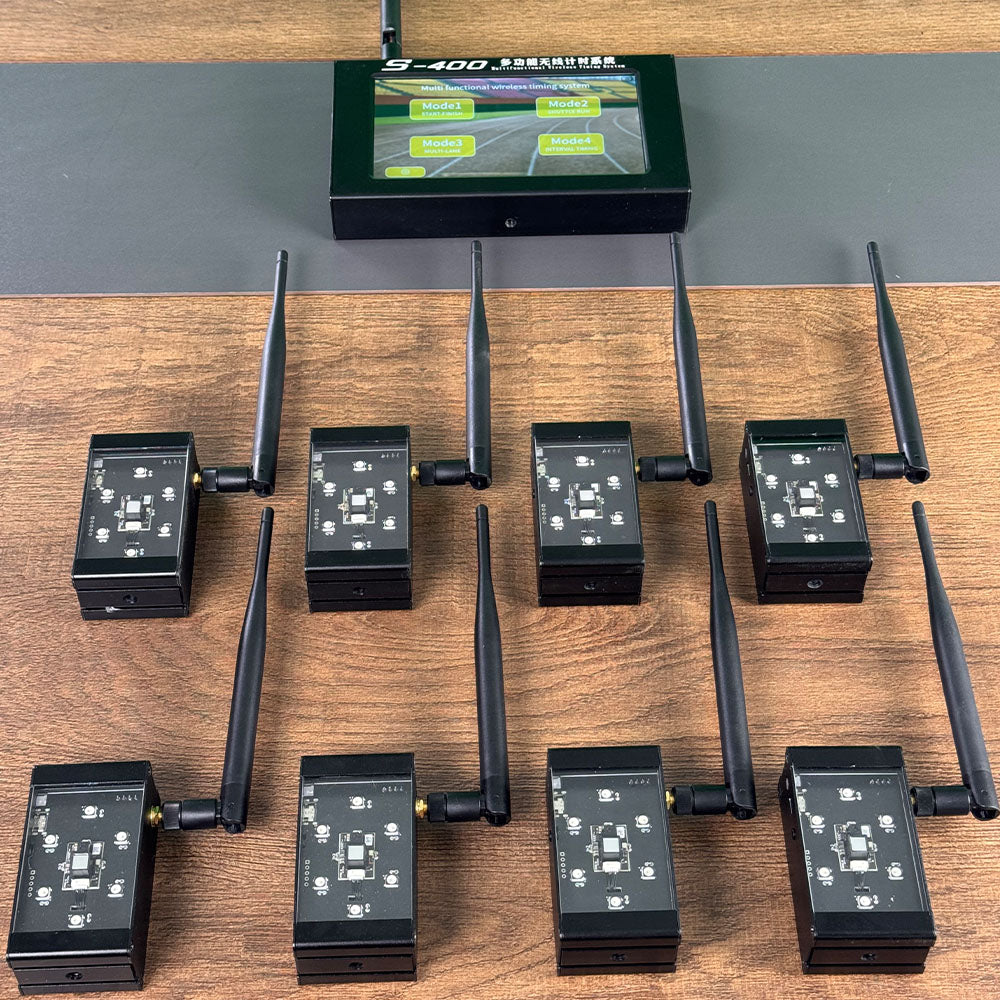
The difference is the trigger, not just the device
A stopwatch records when an operator reacts to what they see. A laser timing gate records a detected passing event according to its setup. In a short sprint, the delay introduced by starting or stopping a watch is part of the recorded result, which makes hand-timed sessions harder to compare when operators or conditions change.
Automatic timing does not remove the need for good testing practice. Gate position, athlete route, start procedure and the selected mode still need to be consistent. It does replace the manual start-and-stop action with a defined trigger point.
What research says about hand timing
Hand timing can still be useful for informal checks and group sessions. In a study of 200 m sprint splits, handheld stopwatch results showed good correlation with electronic timing, but the absolute differences meant that a reliable conversion factor was not possible. The authors concluded that electronic timing should be used when a high degree of precision is required. Read the PubMed study.
Compare the two methods by use case
| Situation | Stopwatch timing | Laser timing gates |
|---|---|---|
| Informal practice | Quick and accessible | May be more setup than needed |
| One-off basic session | Useful for a rough reference | Useful when a defined trigger is important |
| Repeated athlete tracking | Operator reaction can affect comparison | Supports a repeatable trigger workflow |
| Split or segment testing | Hard to operate consistently at several points | Better suited to planned timing locations |
| Shared school or club testing | Depends on consistent operator technique | Helps standardize the timing process |
When a stopwatch is still a sensible choice
A stopwatch can be appropriate for an informal drill, a quick coaching cue or a session where the number is not being used to compare small changes across weeks. It is inexpensive, portable and familiar. The key is to label the result as hand timed and avoid treating it as directly equivalent to a differently collected electronic result.
When laser timing gates add value
Laser timing gates are most useful when the goal is to repeat a test under the same conditions, compare attempts over time, or record several defined locations in a run. They can make the workflow easier to standardize across coaches and sessions, especially for sprint assessments, acceleration work and scheduled testing days.
For a focused sprint setup, review S-009. For multiple planned points, review S-007. If the priority is moving a simple setup between fields, B-01 may be a more practical path.
Use one method consistently within a benchmark
The cleanest comparison is not necessarily the most technical system; it is a method applied the same way each time. Keep the start rule, measured distance, detection path, athlete instructions and timing method consistent. If you move from stopwatch data to gates, record the change in method rather than merging the two datasets as if they were identical.
Choosing the next step
Choose a stopwatch for basic informal timing. Choose laser timing gates when repeatability, a defined trigger point or multi-point testing is important. The sprint timing buying guide helps match that decision to a portable, dedicated or configurable system.
Frequently asked questions
Are laser timing gates automatically better for every session?
No. They are most valuable when the session benefits from a repeatable automatic trigger. A simple informal session may not require the additional setup.
Can I compare an old stopwatch time with a new gate time?
Use caution. The timing method changes the workflow and may change the recorded result. Keep the method visible in your records.
Do gates remove all testing error?
No. Athletes, placement, procedures and conditions still matter. Gates support consistency when the rest of the protocol is also controlled.