01TIMER.COM / Timing system guides / 5-10-5 timing
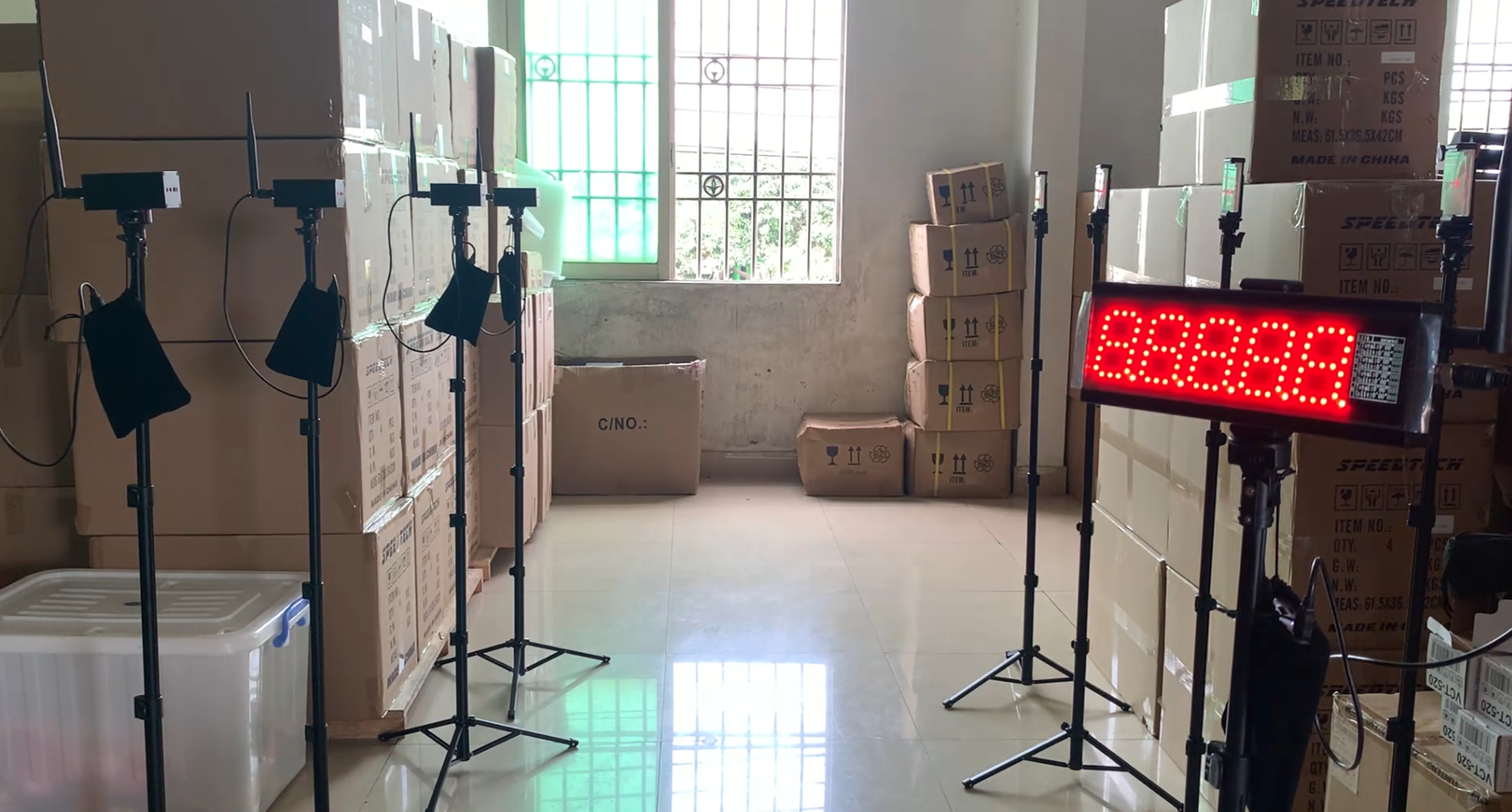
5-10-5 Agility Test Timing: Setup and Recording Guide
The 5-10-5, often called a pro-agility or shuttle test, is a short change-of-direction task. Its value comes from repeating the same route and judging the turn in the same way for every attempt. Timing gates can make the start and finish event easier to record, while clear line rules keep the physical task consistent.
Define the route and turn rule first
The course has a middle start and finish line, with one turn line on each side. From the middle, the athlete runs to one side, reverses direction to the opposite side, then returns through the middle. Mark the three lines before putting down cones or gates so that the course is measured rather than eyeballed.
Decide whether the athlete must touch, cross, or place a foot on each outside line. State that rule during the briefing and use the same observer standard for every trial. A fast result that ignores a turn line is not equivalent to a clean result, even when the final gate time is valid.
Choose how the timer handles the middle line
For a simple 5-10-5 setup, the same middle gate can serve as the start and finish event if its operating mode supports a repeat pass. Some systems use a deliberate start sequence, while others use a configured re-arm interval. Follow the manual for the selected model and test the exact sequence before the group arrives.
Do not change the timer mode halfway through a group. If the system misses a valid return pass, document the problem, verify alignment, and repeat the attempt after the setup has been restored. The goal is a complete record, not an improvised number.
Place gates and cones around the athlete path
- Measure the middle and outside marks and keep a written diagram.
- Set the center timing gate at the middle crossing line according to the equipment manual.
- Place turn-line cones where they cannot be kicked into the gate path.
- Leave clear space for the athlete to decelerate, plant, and leave the line without colliding with a tripod or receiver.
- Run a slow walk-through, then a controlled practice trial, before recording scores.
Use one beam height and one lane arrangement for all athletes in a session. The athlete's arms and shoulders travel differently through a rapid turn than they do in a straight sprint. Changing the hardware position after the first few attempts changes the test conditions.
Brief the athlete with simple, repeatable language
Ask the athlete to begin in the agreed start position, accelerate through the first turn line, travel to the far line, and return through the middle finish. Demonstrate the route once. A complicated explanation increases false starts and makes the event difficult to manage when several athletes are waiting.
Give each athlete a rehearsal without treating it as a scored attempt. The rehearsal checks whether the line rule is understood and whether the gate triggers at the intended point. It also lets you correct a cone that has moved before the official runs begin.
Record more than the final time
| Field | Reason to keep it |
|---|---|
| Final time | The result for the defined 5-10-5 protocol. |
| First direction | Shows whether the athlete began left or right. |
| Turn validity | Distinguishes a clean trial from a missed line or restart. |
| Surface and footwear | Provides context if the session is repeated later. |
| Equipment mode and gate position | Preserves the timing rule used for the data. |
If both first directions are tested, keep them as separate fields. Do not average or compare them until the staff has agreed what question they are trying to answer. A training group may simply want a repeatable conditioning task; a coach reviewing directional movement may need separate observations.
Handle invalid attempts consistently
Set the invalidation rules before testing. Examples may include a false start, a missed outside line, a collision with equipment, or a failed timing event. Tell athletes what will happen after an invalid trial and keep the decision process the same for each person. A short note in the results sheet is better than trying to reconstruct the reason later.
When an unexpected time appears, start with the course: check whether the athlete followed the route, whether a cone moved, and whether a passer-by crossed the beam. Then check gate alignment and the recorded athlete name. Only after these checks should you adjust equipment settings.
Build the result into a repeatable testing workflow
Use the same protocol sheet at the next session. It should include the measured layout, start instruction, turn rule, timing mode, gate height, practice policy, and result fields. That record makes a later comparison more credible than a bare number in a spreadsheet.
Keep the task and the timing rule together: the gate measures a crossing event, while the protocol defines what the athlete had to do before that event counted.
Related timing resources
For a shuttle-focused setup, review the S-002 shuttle run timing system page. For session-level data handling, use the athlete testing data workflow. The shuttle-run measurement guide covers related direction-change setup considerations.
Further reading
For a general overview of the test and the need for a standardised timing-gate protocol, see Science for Sport: Pro-Agility 5-10-5 Test. Confirm your own program's rules before comparing results.