
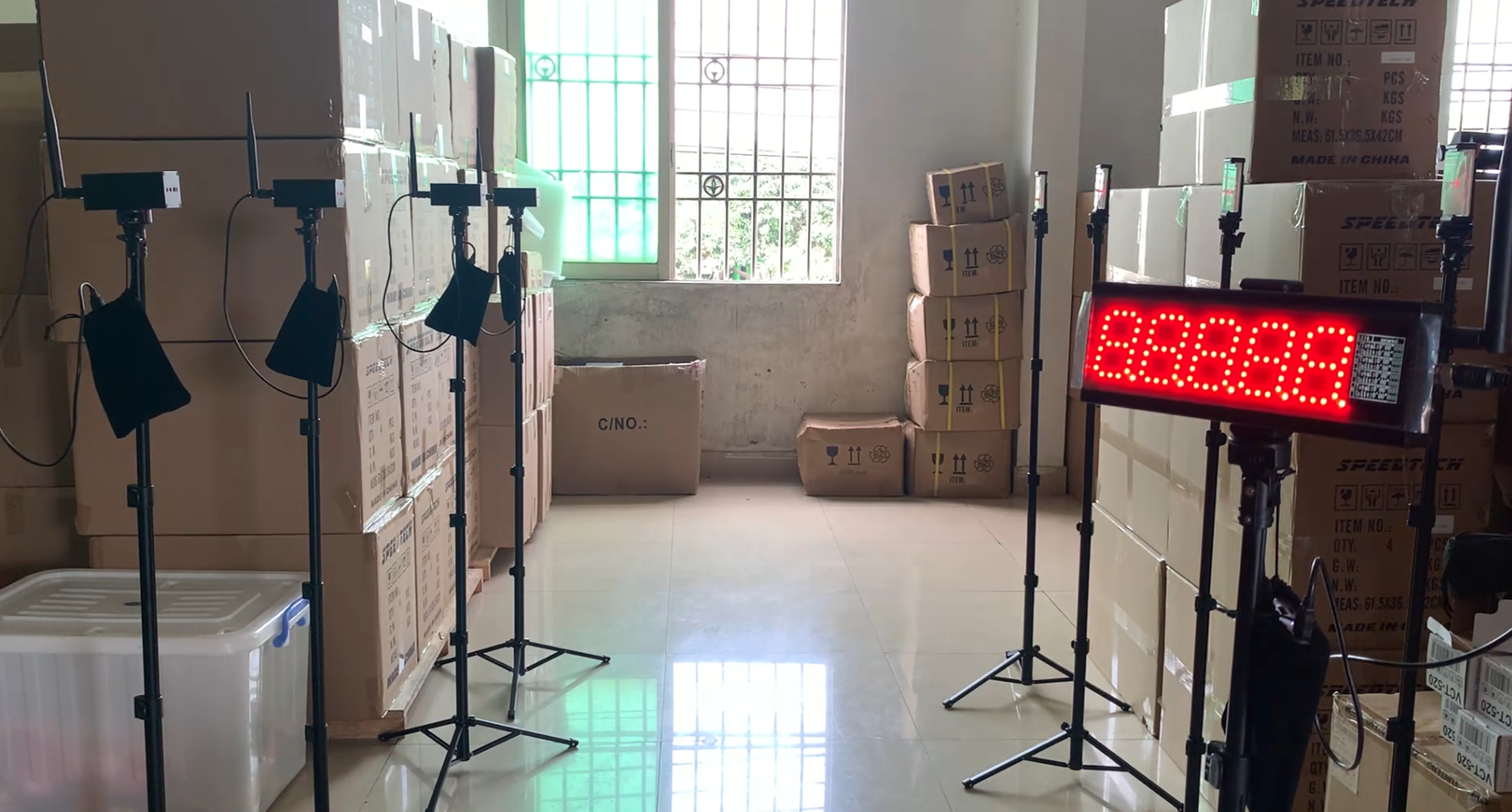
Count the moments you want to measure
The best answer is not a fixed number for every sport. Start by marking each moment that needs a recorded time: the start, the finish, an intermediate split, a turnaround or a controlled pass. Those are the timing points in your test plan. The number of physical sensors or gates needed can vary by model and mode, so confirm that detail before purchasing.
This approach avoids buying extra equipment for data you will not use, while still revealing when a basic start-to-finish kit will be too limited.
Keep timing-light height consistent
The height of a timing light can change the recorded sprint result because different parts of the body may break the beam first. A study of 10 m and 20 m sprints found systematically faster times when lights were set at hip height rather than shoulder height, and recommended standardized procedures for meaningful comparisons. Mark the reference position, keep the height and route consistent, and record a change before comparing results. Read the PubMed study.
A simple decision framework
| Testing question | Typical timing-point plan | What the result tells you |
|---|---|---|
| How long did one run take? | Start and finish | Total time |
| How did the athlete accelerate? | Start, one or more splits, finish | Section-by-section change |
| Can the athlete repeat efforts consistently? | Defined start and finish for each effort | Repeatability across attempts |
| How does a venue handle several sections? | Planned timing points across the route | Operational and reporting workflow |
Start-to-finish testing: keep it simple
For a basic sprint, fitness test or individual speed session, a start point and a finish point are often sufficient. This is the right choice when a final result is the only number used in the session. A portable setup such as B-01 can suit this kind of mobile workflow.
Split timing: add points with a purpose
Add an intermediate timing point when it answers a coaching question. For example, a split may help compare the early and later parts of a sprint, verify a set training segment, or examine a flying section. Do not add points simply because they are available; every added point should have a stable location and a clear interpretation after the test.
Multi-point planning usually points toward a system such as S-007 or S-400. Share the distance, route drawing and the results you want to see so the package can be checked against the model.
Repeated sprints, shuttle runs and returns
Repeated efforts do not always require a new timing point for every run. The important part is defining the same trigger points, athlete route and reset workflow each time. Shuttle or return tests also need a clear turnaround plan, because a return point is only useful when the detection and movement path are consistent.
Venue and event layouts need an operating plan
A route with several sections, a public display or multiple operating staff should be planned as a system rather than as a collection of gates. Map the timing points, identify where the operator stands, decide who can enter the detection area and establish how results are communicated. Use a configured venue comparison if the project is beyond a simple portable session.
Questions to answer before asking for a quote
- What sport or test are you running?
- Where are the start, split, finish and return points?
- How many lanes or routes run at the same time?
- Will the equipment move between locations?
- Do athletes, spectators or staff need a visible result display?
Include those answers in a quote request for a more useful recommendation.
Frequently asked questions
Do two timing gates always mean two physical sensors?
Not necessarily. Product terminology, detection design and timing modes vary. Plan the timing events first, then confirm the required hardware for the chosen model.
Do I need split timing for every sprint test?
No. Split timing is useful only when it informs a coaching or testing decision. A reliable total time can be the best metric for a simple session.
Can I expand later?
Expansion depends on the model and package. Confirm that possibility before buying if multi-point testing is a future requirement.