01TIMER.COM / Timing system guides / 5 m vs 10 m sprint splits
Choosing 5 m or 10 m Sprint Splits for Speed Testing
A 5 m split and a 10 m split are not two ways to display the same result. They time different sections of the run and can point a coach toward different decisions. Choose the spacing first, then keep the start, beam position and result labels stable for the whole testing block.
Start with the coaching question
Use a short split when the session needs to see a change inside a short acceleration phase. Use a longer split when the team needs a simpler profile over fewer timing points or when setup time is limited. Neither choice improves a result by itself.
Write the question in one sentence. For example, the staff may want to compare early acceleration, estimate maximum sprinting speed, or monitor whether an athlete keeps speed late in a run. That sentence determines the split locations and prevents a lane from filling with gates that no one will review.
What each spacing tells you
| Layout | Useful question | What to store |
|---|---|---|
| 5 m splits | Where does acceleration change inside a short sprint? | Each 5 m segment, total distance and start rule |
| 10 m splits | How does the athlete progress across a compact profile? | Each 10 m segment, total distance and start rule |
| 5 m or 10 m flying zone | What is the athlete's speed inside a defined run-in section? | Run-in distance, timed zone and gate heights |
| Finish only | What is the total result for this course? | Start, finish, distance and attempt validity |
A cumulative 20 m time and a 10-20 m segment time are different fields. If the timing system reports cumulative values, calculate the segment only after checking that both points use the same start reference. The 30 m, 60 m and 100 m sprint protocol shows how to label total and split values without combining them.
Use research as a guide, not a universal rule
A 2025 study of 62 female Gaelic football players compared several timing-gate configurations. The reported methods all showed high reliability, with intraclass correlation coefficients of 0.97 to 0.98 and coefficients of variation of 1.0% to 1.2% [source: PubMed 40537135]. The authors recommended 5 m splits over about 30 m for assessing maximum sprinting speed in that population. The result supports a practical choice, but it does not make one spacing correct for every athlete or venue.
A separate study of amateur rugby players compared 5 m and 10 m splits with a radar-gun reference. Both methods were reliable within the session, while 5 m splits matched the criterion measure more closely in the maximum-velocity section. Read the full 2025 timing-gate configuration study and the 5 m versus 10 m maximum-speed study for the populations and methods behind those findings.
Build a layout the team can repeat
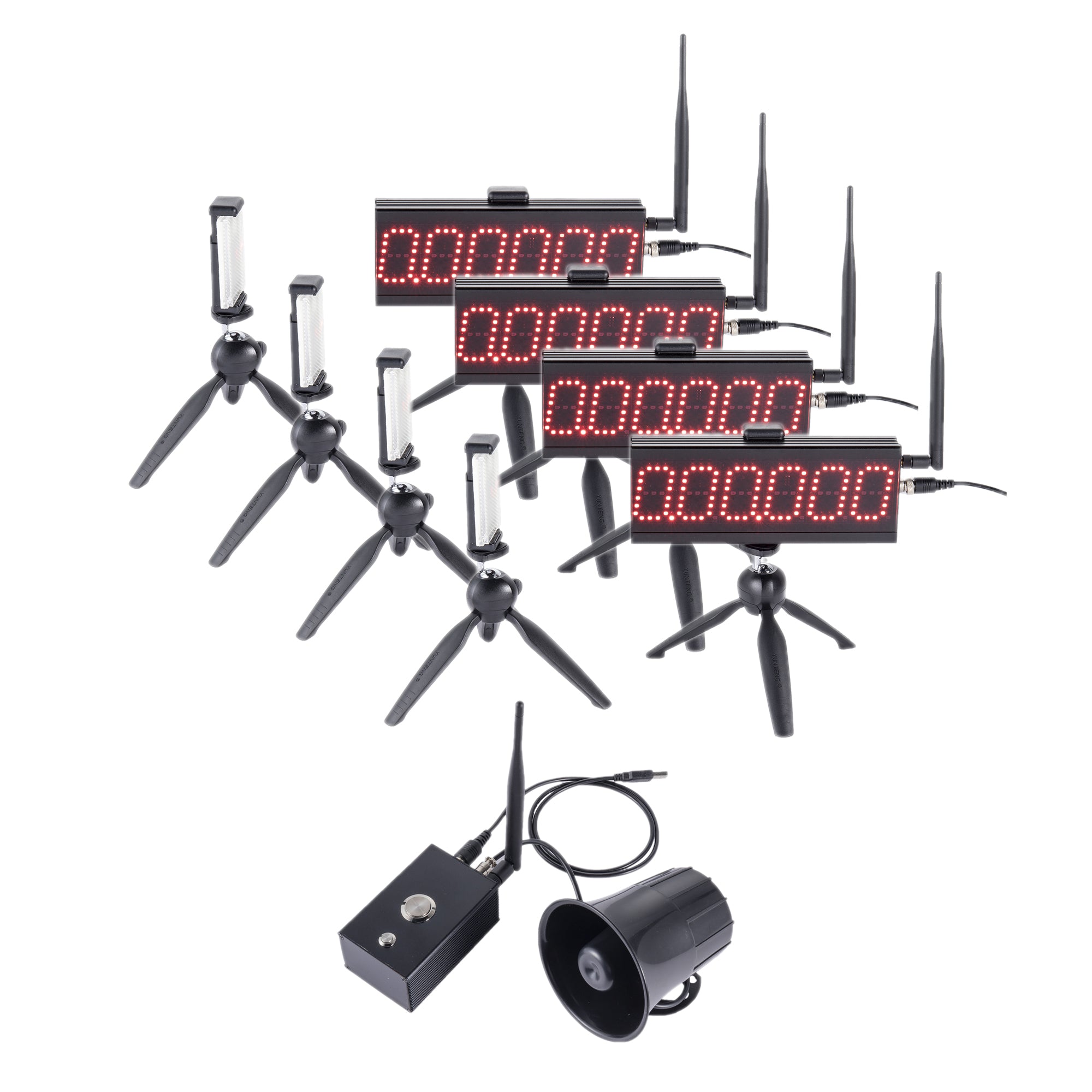
Measure every gate from the same start reference. Mark the points on the surface or create a simple lane diagram that another operator can follow. The S-004 product page describes four-channel split and lane timing, which can suit a four-point profile when the channel map is written before the first trial. A larger multi-point layout may need the S-007 system.
Run a slow walk-through at every point, then make one controlled sprint through the complete layout. Confirm that channel order, distance labels and display values match the physical course. If one gate is moved, start a new setup block instead of appending the new result to the old one.
Keep the start and beam height fixed
Standing, crouch, rolling and flying starts answer different questions. Record the start type in the session sheet and use it for every comparison. The same rule applies to beam height. A study of single-beam timing lights found that different heights changed short sprint measurements and made results hard to compare. Use the timing-light height study as a reminder to document the method, not as a reason to copy one height to every system.
For a flying section, write the run-in distance and the timed zone beside the split. The flying sprint setup guide covers the separate preparation needed when the athlete enters the first gate already moving.
Review changes without overreading them
Keep every valid attempt, not only the fastest one. Review the median or best value according to the protocol, then look at the pattern across the block. A small change should be interpreted with the session's known measurement variation, surface, start and rest conditions. Do not label an athlete as faster because the split spacing changed.
The athlete testing workflow and CSV export guide provide fields for keeping the raw readings, athlete IDs and coaching notes together.
Operator rule: choose 5 m or 10 m because it answers a named question, then keep that choice unchanged for the comparison period.
Questions about sprint split timing
Are 5 m splits always more precise?
No. They provide more timing points, but every point adds setup and review work. The most useful layout is the one that matches the question and remains consistent.
Can one session mix 5 m and 10 m splits?
It can, but label the layouts as separate tests. Do not compare a 5 m segment with a 10 m segment or combine them into one ranking.
How many timing points should a coach use?
Use only the points that will change a decision. Add an intermediate gate when the staff can state what the resulting split will be used to evaluate.