01TIMER.COM / Timing system guides / Youth fitness testing
How to Set Up the ALPHA 4 x 10m Shuttle Run Test Correctly
The ALPHA 4 x 10m shuttle run is not simply four lengths between cones. Three colored sponges and a defined exchange pattern are part of the task. A same-point timer can capture the elapsed time, but the tester must preserve the route, line crossings and two-trial scoring rule.
Read the test as a sequence, not a distance
The ALPHA health-related fitness test manual presents the 4 x 10m shuttle as a measure of movement speed, agility and coordination for children and adolescents. Two lines sit 10m apart. One sponge begins at the start line and two differently colored sponges begin at the opposite line.
At the start, the child runs empty-handed to the far line, collects the first sponge and returns. At the start line, that sponge is exchanged for the sponge waiting there. The child carries the second sponge to the far line, exchanges it for the third and runs back through the finish.
That is four 10m lengths and three object interactions. A test without the exchanges may still be a useful shuttle drill, but it is not the same ALPHA protocol.
Build the 10m lane and sponge stations
Measure two parallel lines 10m apart on a clean, non-slip floor. The manual lists adhesive tape, a tape measure, four cones and three differently colored sponges. Use the colors in the score sheet or route brief so the observer can catch an out-of-order exchange.
| Position | Before the start | Tester check |
|---|---|---|
| Start/finish line | Sponge B behind the line | Child starts just behind the line |
| Opposite line | Sponges A and C behind the line | Both feet cross on each visit |
| Running path | Clear 10m lane | No cones or cables in the turn area |
| Finish | Same line as the start | Child runs through without slowing early |
Keep the sponges far enough from the timing hardware that the child can reach them without striking a tripod. Run the power cable away from the turn zone. A mat, bag or loose tape edge near the exchange point changes the movement and creates a trip risk.
Place S-002 at the common start and finish line
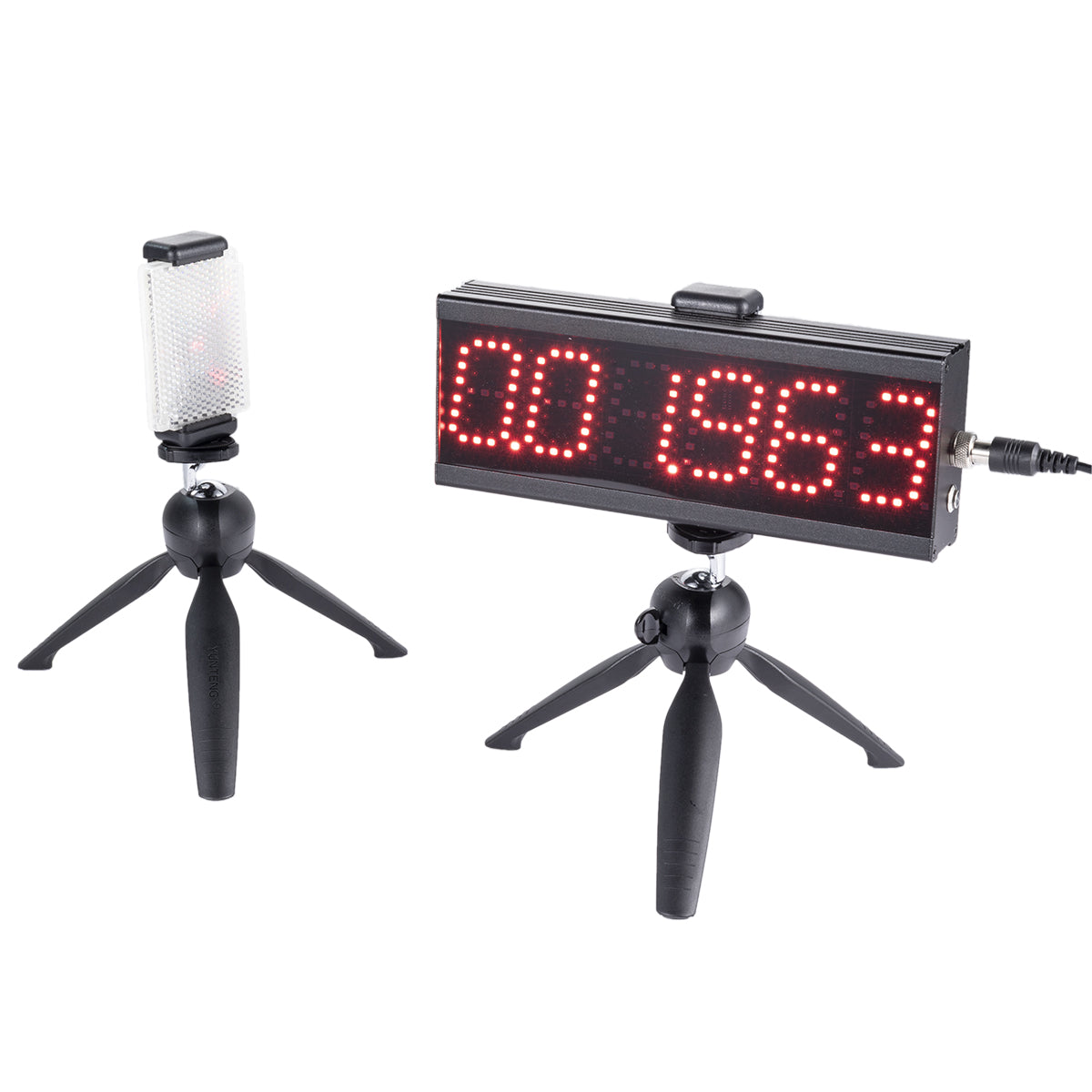
The S-002 is described as a turn-back timing system for a test that starts and finishes at the same point. That geometry matches this 4 x 10m route. It does not, by itself, make the result an ALPHA score; the staff still needs to follow the published administration.
Test the chosen start routine with the beam and controller before the child enters the lane. The beam should capture the intended finish crossing without being interrupted by a sponge exchange, a waiting child or the observer. Keep its position and height unchanged across both trials and all participants.
Use the manufacturer's setup guidance for the actual device controls. The wireless connection check and beam alignment guide are useful before the rehearsal, not during a scored attempt.
Assign three jobs during each attempt
One tester can run a small session, but three clearly separated jobs reduce confusion: start and timing, line/exchange observation, and result recording. In a larger class, a fourth person can stage the next child away from the active lane.
The observer calls each completed length and watches both feet cross the required line. The recorder notes a dropped sponge, missed line, slip or route error immediately. The timing operator confirms device readiness and reads the result. No one should try to fix the sponges while the child is still moving.
The manual says the tester demonstrates the correct performance. Let the child walk the exchange pattern before the first timed effort. Familiarity matters here because the score includes the object-handling task, not only running speed.
Run two trials and preserve both raw results
The ALPHA manual calls for two trials and reports the best time, scored to one decimal place. Keep the unrounded electronic reading in the session record if available, then apply the required reporting precision in a separate field. That avoids losing the raw value while still matching the protocol's published format.
Record rest conditions between the two attempts and use the same schedule for the group. The manual's result table is tied to its protocol and population. Do not apply those reference categories to a modified route, a different age group or a time collected under a different crossing rule.
A recent adult study in the Journal of Science and Medicine in Sport compared trained and untrained raters with photoelectric timing in a 4 x 10m protocol. Its findings reinforce a practical point: staff training and a consistent method belong in the test record. The adult sample does not replace the youth ALPHA manual.
Keep school testing safe and auditable
The ALPHA manual calls for a non-slip surface and a warm-up before the movement tests. Follow your school's screening and participation rules. Stop the test when a child shows a problem or when the course becomes unsafe.
Write down the manual edition, lane measurement, timing device, beam position and trial status. The school testing template helps standardize the record, and the class rotation plan keeps waiting children out of the route.
Questions about the ALPHA 4 x 10m test
How many sponges are used in the ALPHA 4 x 10m test?
The ALPHA manual specifies three differently colored sponges: one at the start line and two at the opposite line. The athlete carries or exchanges them during the four 10m lengths.
How many ALPHA 4 x 10m trials are recorded?
The manual calls for two trials and uses the best time as the score. Keep both raw trials and mark which one becomes the reported score.
Does electronic timing change the sponge-exchange rules?
No. A timer records elapsed time; the tester must still enforce the line crossings, route and sponge exchanges required by the protocol.
Rehearse the objects before the clock
Lay out the three colors, walk the child through A-B-C and make the line observer repeat the same sequence back. Then test the beam with one full practice route. If the staff cannot agree on what counts as a correct exchange, the session is not ready for scored trials.
Once the route is stable, keep it stable. That is what makes the second trial and the next testing day worth comparing.