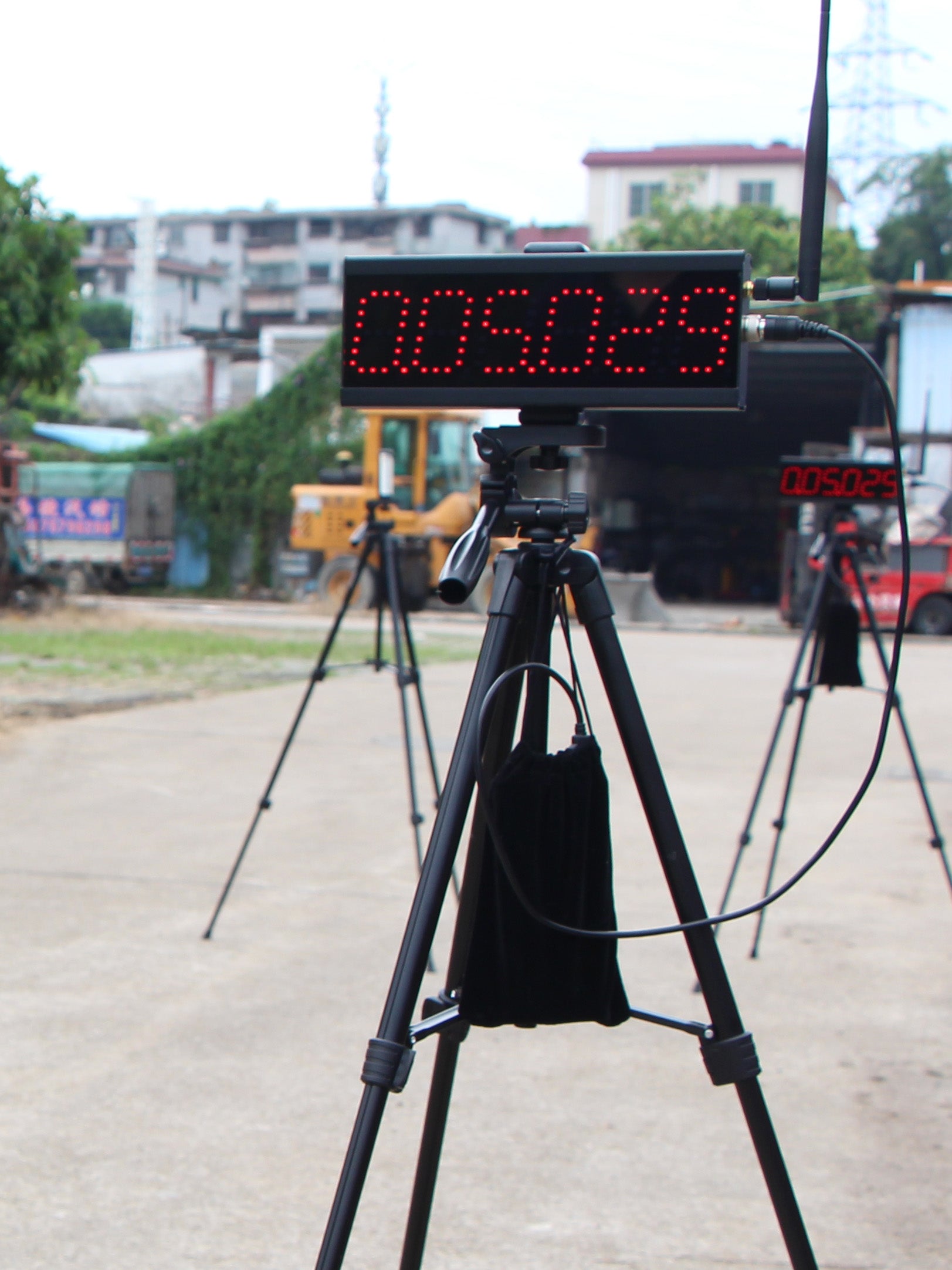
Fixed-plane timing
Records elapsed time between configured crossing points. The distance and start event are visible on the test map.
Field tracking
Estimates speed, distance or movement from a wearable's position samples and its processing method.
Start with the variable, not the device
A 10 m split and a high-speed running total answer different questions. If a coach wants to know how fast an athlete crossed a defined 10 m lane from a specified start, timing gates give a direct elapsed time for those planes. If the coach wants to see where an athlete moved during a small-sided game, a wearable may describe more of that session.
The distinction matters because a device name does not define the result. A GPS report may display speed in a 10 m window, but the value depends on the device, sample rate, smoothing and calculation. A gate time also depends on its start rule, beam placement and the athlete's path through the line. The report should state which event produced the number.
Before comparing two test days, write down the distance, start position, trigger rule, lane, warm-up and device. A changed start instruction can move the result even if the athlete's underlying acceleration is similar. The start-method comparison explains why a standing start and a triggered start should not be treated as one protocol.
What the comparison studies found
Waldron and colleagues tested 19 elite youth rugby league players using 5 Hz GPS and timing gates during two over-ground sprints. In that study, GPS underestimated distance and gate-derived speed; the gate measurements also showed lower variation for the equivalent sprint measures. That is evidence about the devices and protocol they tested, not a verdict on every GPS unit sold today. The 2011 study record is a useful warning against assuming that two systems share the same scale.
A later study asked a narrower question: maximum velocity over 40 m. Nine professional rugby union players ran three 40 m sprints while researchers compared 10 Hz GPS, timing gates and a 50 Hz radar gun. Both the GPS and gate measures showed small estimation error against radar under that setup. The authors still advised using the same protocol over time because differences remained between measures. The PubMed abstract supports a practical distinction: validity for one tested variable does not make every output interchangeable.
| Question | Better starting point | Record with the result |
|---|---|---|
| How long did the athlete take over a 10 m lane? | Timing gates at fixed start and finish planes | Distance, start event, gate height and surface |
| How much high-speed movement occurred in practice? | A suitable GPS tracking workflow | Device and software version, sampling and speed definition |
| Did maximum velocity change in a 40 m test? | Either method only if the selected protocol is validated for that use | Device, run distance, start, warm-up and processing method |
Short sprints are a demanding measurement
At a short distance, an athlete spends much of the run accelerating. A small timing difference can therefore have a visible effect on the reported average speed. A GPS-derived peak speed, a 10 m gate time and a 40 m radar peak are related observations, but none is simply a different label for the others.
That is why a faster displayed value does not automatically mean a better measurement. Ask what the display calculated, how the start was defined and whether the same process was used last month. For fixed sprint benchmarks, keeping those choices stable is more useful than switching among devices because one report looks more precise.
Build a repeatable gate test
For a simple start-to-finish benchmark, mark the same distance and align the start and finish gates with the same crossing height on each visit. Use the same instruction for every athlete. If the system uses a command start, decide whether the result begins with the command or with a sensor event, then check that mode before the first recorded attempt.
The S-009 product page describes a sprint laser timer for short sprint training and start-to-finish tests. It lists voice-start support and a control unit, display and reflector package. Those product details describe the published package; coaches should confirm the current mode and included equipment against the page before ordering. The S-009 field decision guide covers the solo setup and its start choices.
For a team's wider movement load, GPS can sit alongside a gate test rather than replace it. Use each data stream for the question it measures, and avoid merging them into a single trend line unless the calculation has been validated for that purpose.
Decide what the next session should answer
If the question is a fixed-distance sprint time, use a measured lane and a stable start definition. If the question is how an athlete moved through an entire practice, use the field-tracking method that fits the activity. A coach can use both in the same week, but the reports should keep their labels separate.
That simple separation makes later reviews easier. The data stays tied to the event that produced it, and a change in equipment does not masquerade as a change in performance.
GPS and timing gate questions
Can a GPS report replace a 10 m gate split?
Only if the GPS device and calculation have been validated for that exact measure and protocol. A sampled speed window is not automatically the same as elapsed time between two crossing planes.
Can a gate system measure total practice distance?
Gates record configured crossing events. They do not track an athlete's full path around a field.
Should the test use the same device each season?
For a longitudinal comparison, keep the device, start method, distance and processing rules consistent. If you change the method, document the change and avoid comparing values as though nothing changed.
Sources
- Waldron, Worsfold, Twist and Lamb (2011), Concurrent validity and test-retest reliability of GPS and timing gates to assess sprint performance variables, Journal of Sports Sciences.
- Jenkins et al. (2017), Validity of 10-Hz GPS and timing gates for assessing maximum velocity in professional rugby union players, Journal of Strength and Conditioning Research.
- 01TIMER, S-009 sprint timer product details.