01TIMER.COM / Timing system guides / route measurement
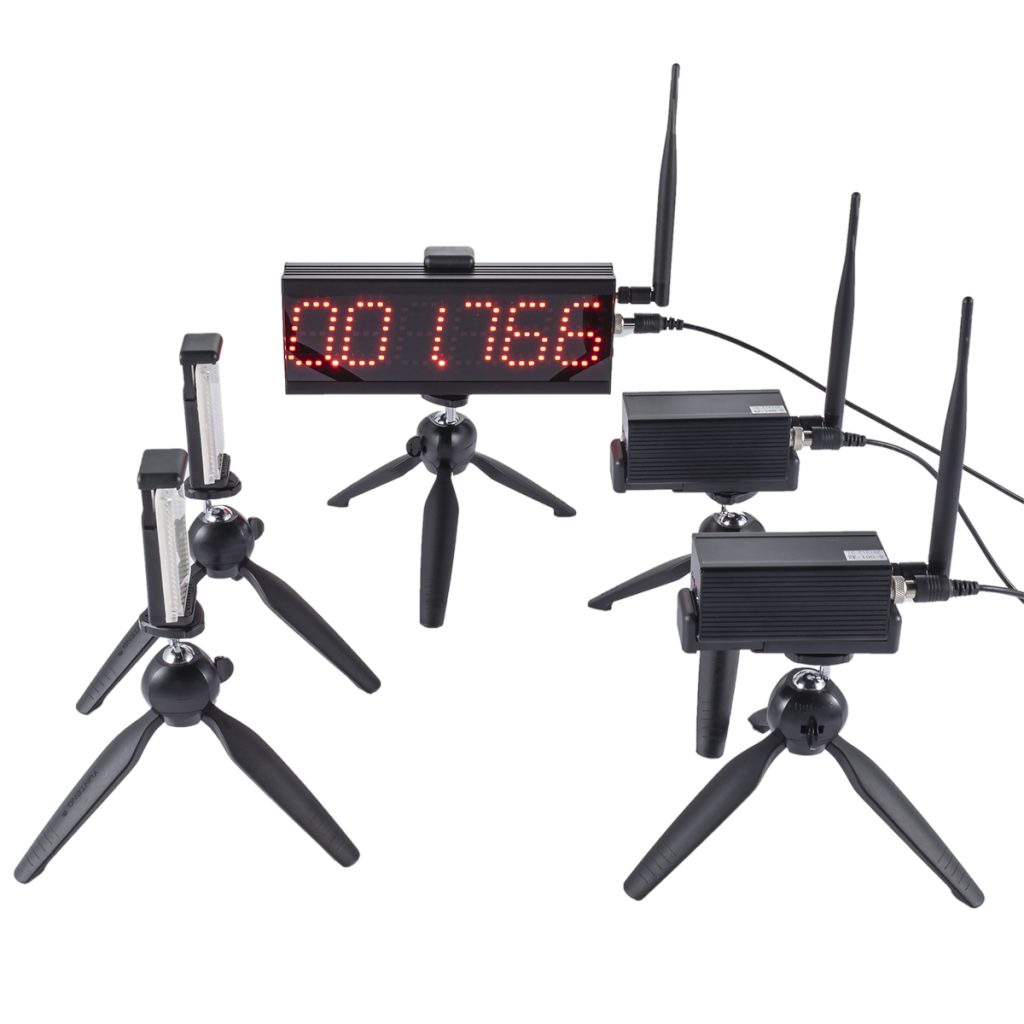
S-006 vs S-007: One Finish Time or Several Splits?
The S-006 vs S-007 comparison starts with two questions. How long did the full route take? Or where, within that route, did the athlete gain or lose time? Each model begins on a different side of that choice.
Result test
Write the result fields before drawing the hardware. One elapsed-time field points toward S-006. Several named split fields point toward S-007.
S-006 measures the route as one interval
The current S-006 product page describes a long-distance wireless laser timer for a single person's start-to-finish time. Its published package has a start laser, finish laser, one LED display, two reflectors, five tripods, three antennas, power cables, a screen clip and a case.
This layout fits a venue that cares about the complete journey between two fixed lines. Examples include a long outdoor sprint lane or another measured route where the final elapsed time is the intended record. The operator still needs a clear start rule, a protected finish and a way to communicate between the two stations.
S-007 divides the route into named sections
The S-007 product page describes advanced laser gate timing for interval, segment and multi-track layouts. It lists a controller, laser timing gates, tripods, wiring accessories and setup support, with an optional LED display available by quote.
The number of useful timing points comes from the measurement plan. A gate at 10 m has a job only when the resulting 10 m value will be reviewed. Extra crossings that nobody can name or interpret increase setup work without improving the session.
Compare the result before the equipment
| Question | S-006 direction | S-007 direction |
|---|---|---|
| Primary output | One start-to-finish time for a long route. | Several interval or segment records. |
| Station plan | Start, finish and display or control positions. | Controller plus each named timing point. |
| Published communication information | Best conditions within 3 km; typical conditions 1.5 to 2 km. | Confirm site conditions and the selected operating mode. |
| Data review | Validate start, finish and complete elapsed time. | Validate timing-point order and every split identity. |
| Typical mistake | Treating the published range as a substitute for a site test. | Adding gates without a defined result question. |
Treat range figures as a site-test trigger
S-006 publishes best-condition communication within 3 km and typical conditions from 1.5 to 2 km. The same page tells buyers to confirm outdoor conditions. Those figures help shortlist the model, but terrain, buildings, trees, elevation and station orientation still belong in a full-route rehearsal.
S-007 does not publish one general communication figure on its current product page. It asks buyers to confirm site conditions, accuracy and power by model and mode. Keep that distinction in the buying notes. Do not copy the S-006 range into an S-007 plan.
The S-006 course survey gives a route-walk checklist. For changing outdoor conditions, attach the notes described in the outdoor timing guide to each result set.
Give every remote station an owner
A longer route creates distance between people as well as equipment. Name the person responsible for the start, the finish and every intermediate point. Define how staff report a blocked route, moved stand, alignment problem or lost communication. One phrase should stop the next start across the whole crew.
S-007 adds more station identities. Use the same labels on the course map, hardware and result sheet. The S-007 layout guide explains that naming method. If the route includes a flying sprint zone, use the flying sprint guide to separate the run-in from the measured section.
Check whether splits will change a decision
List the decisions made after the session. A coach may use a split to compare early acceleration with a later phase. An event organizer may only need the official finish time. If removing a planned split leaves every decision unchanged, that point has no present job.
There is also a data cost. Each additional timing point needs a stable field name, expected order and exception rule. The athlete timing data workflow shows how to keep those fields tied to the correct person and protocol.
Rehearse the result, not just the signal
Place the full system at the intended stations and run one controlled trial. For S-006, confirm that the start event, finish event and displayed elapsed time follow the written protocol. For S-007, confirm that each split arrives under the correct label and in the correct order.
Then run a failed case. Move near a beam, enter a station out of order or interrupt communication according to a safe test plan. Staff should know how the result is flagged and when the course must be reset. Keep the acceptance record with the route map.
Measurement rule: choose S-006 when the full-route time is the result. Choose S-007 when named intermediate points answer separate questions. Confirm the final package and site conditions with the completed route map.
Questions about long-route timing
Is S-006 a multi-split system?
Its current page describes single-person start-to-finish timing. A requirement for several intermediate results points toward a multi-point system such as S-007.
Can S-007 be used on a long route?
The product page describes interval, segment and multi-track layouts, but it does not publish one universal range or package for every route. Send the actual distances and obstructions for confirmation.
What belongs in the quote request?
Include the route map, timing-point names, distances, elevation or obstructions, operator positions, display need and result fields in the request-a-quote form.