Why a short sprint can distort the profile
Coaches often want more than a finish time. A sprint force-velocity profile estimates how horizontal force and velocity change as an athlete accelerates. The calculation uses split times, body measurements and a model. Timing gates provide crossing events; they do not measure force directly.
That distinction places the course inside the method. If the gates stop at 15 or 20 m, a calculation built to describe the full acceleration phase has to work with an abbreviated record. The resulting profile may then reflect the gate layout as much as the athlete.
Haugen, Breitschädel and Samozino tested this setup problem with 25 male and female team-sport athletes. Each athlete ran two maximal 40 m sprints, with dual-beam gates at 5 m intervals. The researchers calculated profiles from 12 combinations of three to eight timing checkpoints. Their paper reports that a 10, 20 and 30 m checkpoint set was sufficient for valid and reliable outputs in that sample. The PubMed record also notes that setups covering only the first 15 to 20 m performed less well on some estimates than longer arrangements.
The paper tested a particular model with team-sport athletes running a maximal 40 m sprint. The 10, 20 and 30 m result is a supported setup for that research context, not a universal rule for every athlete, distance or analysis package.
Map the measured planes before placing tripods
Start with the timing events in writing. Mark the start, 10 m, 20 m, 30 m and finish on a course sketch. Measure each distance along the running line and note which direction each athlete crosses. A gate placed on the wrong side of the tape can shift every split even if the display reports to a thousandth of a second.
For the study's three-checkpoint arrangement, gates at 10, 20 and 30 m record cumulative times from the start, assuming the system mode is configured that way. A segment time between 10 and 20 m is a different field; it is calculated from the cumulative observations or returned directly by a suitable mode. Label the output before testing. The cumulative-versus-segment guide shows how to name those fields without mixing them.
| Checkpoint | Question it supports | Course note |
|---|---|---|
| 10 m | How much time elapsed in the first 10 m? | Keep the start position and triggering event fixed. |
| 20 m | How much time elapsed by the second mark? | Measure from the same start line, not from the 10 m tripod. |
| 30 m | What is the cumulative time through later acceleration? | Use a clear run-out so the finish does not change the approach. |
| 40 m finish, when used | Did the protocol include the full 40 m effort? | Separate the finish time from the three profile checkpoints. |
Keep the model and the course in agreement
A timing gate output is not itself a force-velocity profile. The analysis method determines which splits to use and how to derive mechanical estimates. A 2019 study comparing a single-run and multiple-run force-velocity method found poor agreement between their relationships; the authors said the two methods appeared to measure somewhat different sprint properties and should not be used interchangeably. The PubMed abstract makes the same point for testing choices: name the calculation as well as the device.
Record the model or calculator version, body mass and height if the selected method requires them, and the exact split set. Do not compare a profile created with one method to a result built from another just because both reports use labels such as F0 or V0.
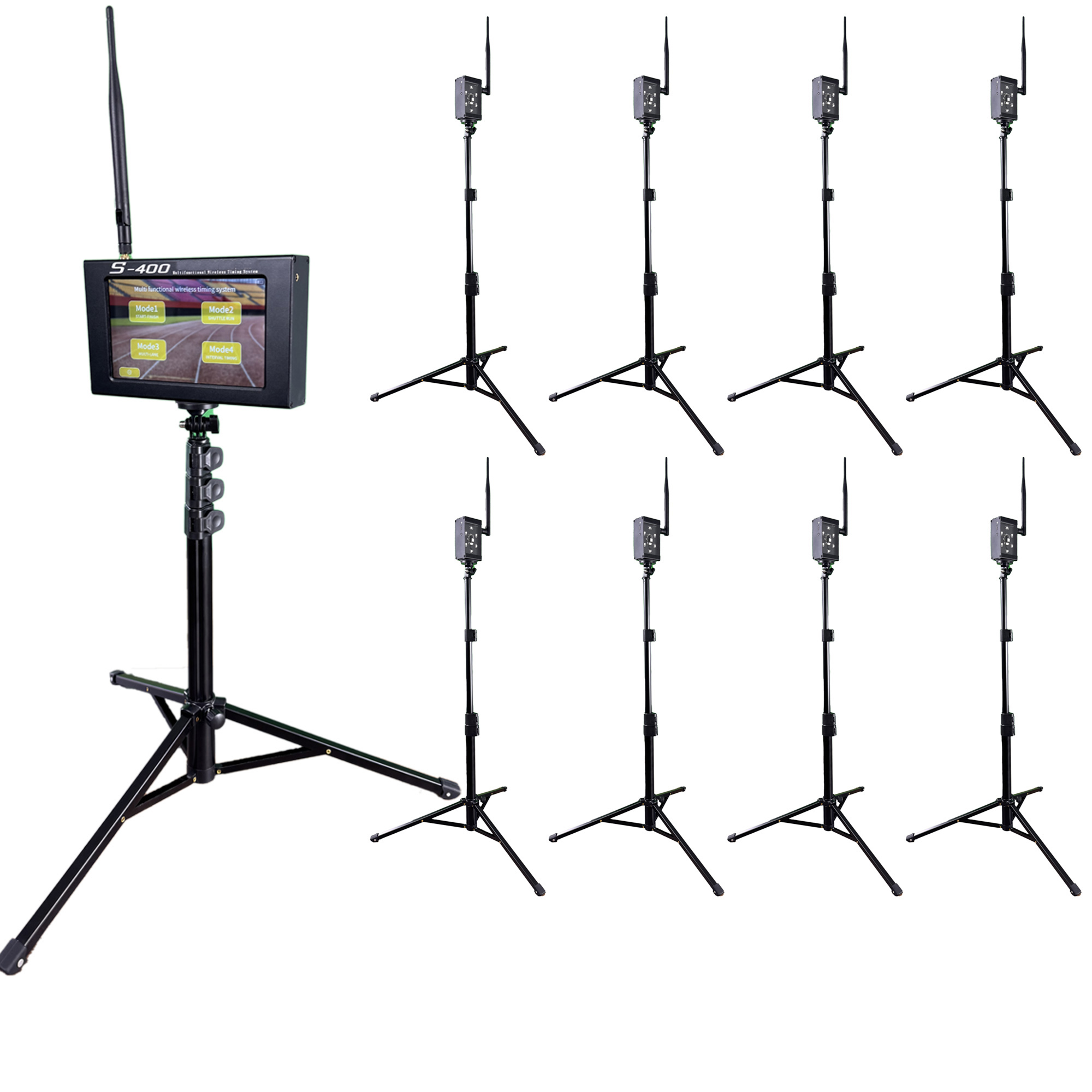
The S-007 layout guide covers the physical planning of multiple crossing points. The S-400 product page describes configurable sensor packages for multi-point timing and says the selected package and mode depend on the requested setup. Confirm the required number of sensors, distances, mode and result fields before ordering; a product page does not replace the analysis protocol.
Make the sprint repeatable for the athlete
Use the same surface and footwear policy each visit. Apply the same warm-up, recovery between attempts, start cue and instruction. If the research result you plan to use depends on a maximal sprint, submaximal trials will not answer the same question.
Practice the route before recording. One operator can walk each beam and verify that the receiver shows the expected station order. Then have one athlete complete a controlled rehearsal while another person checks the labels and export. Fix a misnamed split before a whole squad produces data that needs to be discarded.
For a broad sprint benchmark rather than a mechanical profile, a simpler start-to-finish test may be enough. The 30 m, 60 m and 100 m guide discusses test distances and what those finish times can say. More gates make sense only when each point answers a coaching question.
Use enough course, not the most equipment
The study supports coverage across the acceleration phase and identifies three useful checkpoints for the protocol it tested. That is a better starting point than adding a sensor at every five metres by habit. Choose the course, model and split set together, then keep them stable when tracking change.
Does the timer calculate force?
No. It records gate events. A separate validated model uses sprint splits and relevant athlete data to calculate mechanical estimates.
Can I stop at 20 m?
You can run a 20 m sprint test, but do not assume it yields the same full-acceleration profile examined in the cited paper.
Do I need gates every 5 m?
The researchers compared several arrangements and reported that three checkpoints at 10, 20 and 30 m were sufficient for their tested model and participants.
Can I move a gate between sessions?
Only if you update the course record and avoid treating the resulting profile as a direct continuation of the old setup.
Research and product sources
- Haugen, Breitschädel and Samozino (2018), Power-Force-Velocity Profiling of Sprinting Athletes: Methodological and Practical Considerations When Using Timing Gates, Journal of Strength and Conditioning Research.
- Haugen, Breitschädel and Seiler (2019), Force-velocity profiling of sprinting athletes: single-run vs. multiple-run methods, European Journal of Applied Physiology.
- 01TIMER, S-400 configurable timing-system details.