01TIMER.COM / Timing system guides / home-to-first timing
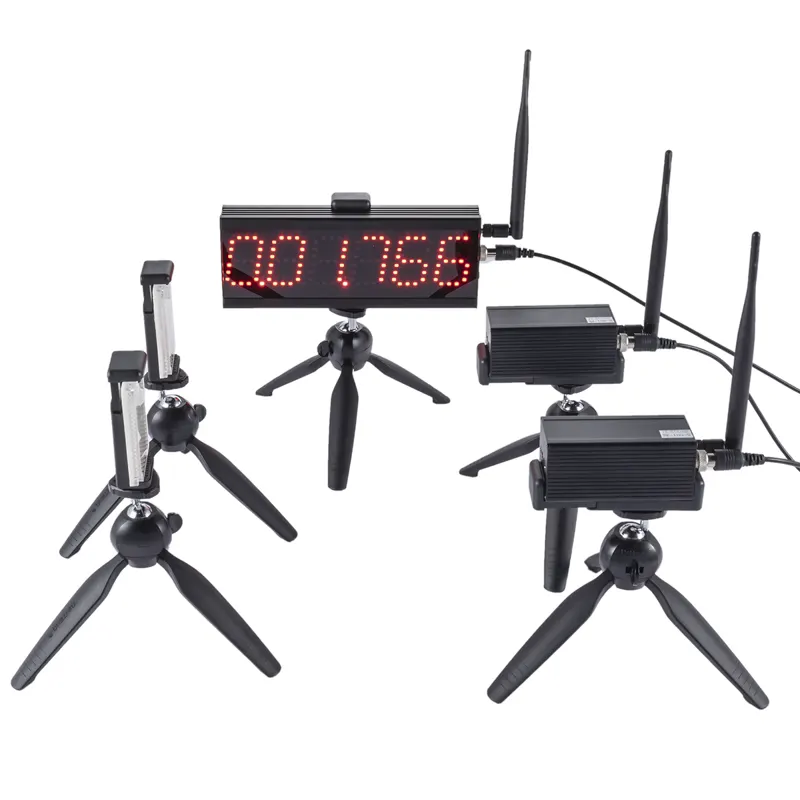
Home-to-First Timing Gates: A Repeatable Baseball Test
Home-to-first is often discussed as one number, yet the number depends on where the clock starts, where it stops and how the runner travels between those points. A consistent test does not need a complicated setup. It needs a route that is measured, visible and recorded in enough detail to rebuild later.
Define the question before marking the lane
Decide whether the session is evaluating the complete play from contact, the runner's first movement or a pure acceleration segment. Those are different tests. Name the protocol before placing the equipment so the start instruction cannot drift when several athletes rotate through.
If the work is intended for selection or development, write down who will use the result and what decision it supports. A practice benchmark can be valuable without being presented as an official game measurement. Check the relevant league or governing-body rules whenever a result will be used for formal verification.
Measure the actual route at your venue
Use a fixed reference for the start and finish, then measure the route that runners will actually take. Note whether the athlete leaves the batter's box, runs on the foul-line side or follows a coaching marker. Do not assume that a familiar field creates identical geometry at every venue.
Mark both points clearly and photograph the setup if the field will be tested again by a different staff member. Keep the finish gate far enough from the base or wall to leave a safe deceleration area. The beam-height and alignment guide is useful for checking that the trigger point stays stable after the units are moved.
Choose a start convention and keep it
| Start convention | What it includes | How to document it |
|---|---|---|
| Contact or release start | The clock begins at the defined bat-contact or release event. | Describe the signal, operator action and how a foul or missed contact is handled. |
| First-movement start | The clock begins when the athlete breaks the start beam or leaves a marked point. | State the stance, trigger point and whether rocking or a false step invalidates the attempt. |
| Flying segment | The athlete enters a separate timed zone after an approach. | Record the approach distance and the exact timed-zone marks. |
A single-person system can suit a focused individual lane. Review the S-001 setup guide and the current S-001 product page for published model information. The equipment choice should follow the route and staffing plan, not replace them.
Rehearse the finish and the run-out
Before the first scored attempt, have an operator walk through the beam and confirm the expected display response. Run one controlled rehearsal at reduced speed. Watch for a catcher, coach, loose ball or nearby runner crossing the beam. Decide who calls an invalid attempt and how the athlete will receive the next start.
Keep the finish event unambiguous. If the beam is placed beside a base, state whether the runner's torso, leading shoulder or another defined body passage is the trigger. Do not move the finish gate to make a result look faster or slower during a block.
Separate hitting context from running context
Some programs want a contact-to-first result; others want a sprint test that begins from a repeatable stance. Store the two conditions separately even when they share a lane. Include the bat, ball, footwear, surface, warm-up and rest plan in the session note when those details affect the task.
When a contact-start trial produces a foul, miss or hesitation, mark the status rather than deleting the row. A clear invalidation reason helps the athlete and protects the comparison from silent editing.
Build a result record that survives the season
Use one row per attempt with athlete ID, date, protocol, route, time, validity and notes. At the top of the session, record gate positions, beam height, start device, operator and venue. The athlete data workflow and CSV export guide show how to keep these fields together when a roster grows.
Review a best time alongside the full set of valid attempts. A spread of results can reveal a start inconsistency, fatigue or a route problem that a single headline number hides. If the venue changes, begin a new comparison group and keep the old geometry in the archive.
Compare only like-for-like results
Before calling an athlete faster, align the start convention, route, surface, gate positions, equipment state and validity rule. If one item differs, describe the comparison as limited. The cross-session comparison guide offers the same principle for another field test: context is part of the measurement.
Baseball rule: a route label such as “home-to-first” is not a complete protocol until its start, finish and path are written down.
Questions about home-to-first timing
Do I need to use the game field?
No. A training lane can work when its route is measured and its surface and marks are recorded. Keep field and indoor results in clearly labeled groups.
Can two athletes run at once?
Only when the lanes, timing channels and run-out areas are independent. A dual-track workflow explains the extra alignment and lane checks.
Should a poor start be counted?
Follow the rule written before the session. Mark a prescribed invalid start and repeat it under the same rest plan; do not quietly substitute a different attempt.