Reliability answers only one question
The modified pickleball spider test asked players to sprint between cones, return to a marked square and move backward on some legs. Researchers recorded split and total times with timing gates. Across five full-effort trials, the test showed an intraclass correlation coefficient (ICC) of 0.977. The sample included 36 adults aged 19 to 78. Falknor, Martin and Kim's study also found a learning effect between the first and second trial.
Those statistics tell a coach that repeated scores were similar in that study after a warm-up, practice trial and rest between attempts. They do not establish that every movement in the test is appropriate for every recreational player. Reliability is a property of the measurement under a protocol. It is not a safety clearance.
Why the authors advised against the test
Some older participants raised concerns about the backpedaling task, and one person fell while moving backward. The participant was not injured, but the authors still concluded that they did not recommend the modified spider test. Their concern was not that timing gates failed. It was that a test built around fast, repeated court movement should be judged on more than whether the timer returns a stable number.
A separate study of recreational pickleball players used a modified T-test and asked about falls during play. Among 92 participants, 42% reported at least one pickleball-related fall; lunging and backward movement were commonly reported reasons. Participants with a fall history were older and slower on the study's change-of-direction test. Myers and Hanks used a cross-sectional design, so these findings describe associations. They do not show that a test caused a fall or that a slower score predicts an individual player's next injury.
The test study observed one fall during a test. The separate survey study asked about falls during recreational play. They are different observations, in different samples, and neither gives a personal risk prediction.
Keep the timing method separate from test selection
The spider-test researchers used three pairs of timing gates to record splits and total time. Hand timing was also compared with gate timing by the same two research assistants. Agreement in that sample does not mean every manual time or every gate arrangement is interchangeable. Start position, body reference, beam height, course marks and the person calling a trial all affect what the recorded value represents.
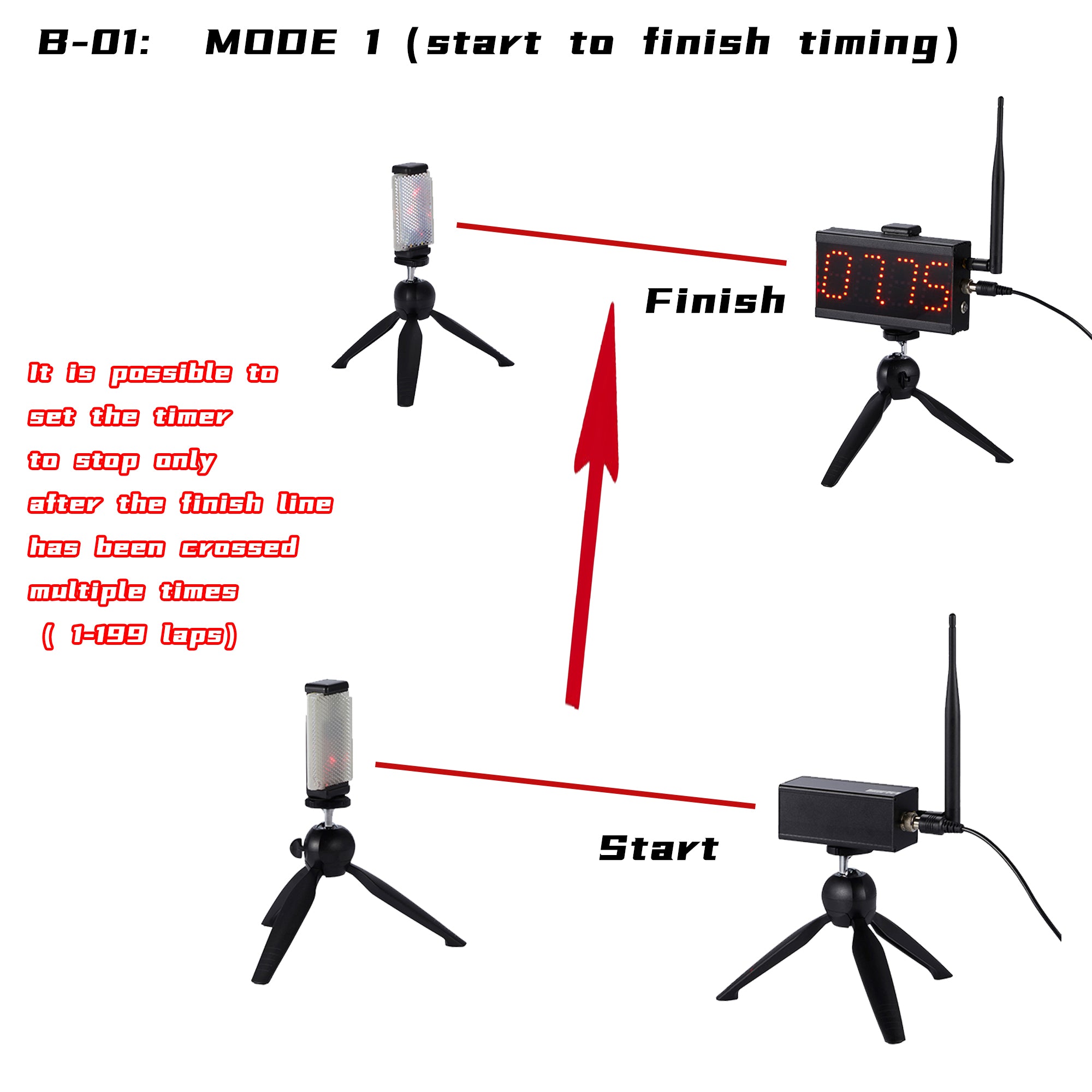
A beam-break timer can report when a player crosses a set plane. It cannot verify a cone touch, confirm that the player returned fully to a square or decide whether a backward movement was controlled. Use a written checklist or an observer for those parts. If the question requires several event splits, confirm that the selected system and timing mode support that exact layout before setting up the full court.
| Question | What the timer can answer | What still needs review |
|---|---|---|
| How long was the course? | Elapsed time between configured beam events | Whether the route was completed correctly |
| Was the cone touched? | Not from a beam crossing alone | Observer or a separate touch-detection method |
| Was a split faster? | Yes, if the split plane and label stay fixed | Whether the difference exceeds normal test variation |
| Is this test a good choice? | No timing system can decide that | Participant ability, movement demands and session risk review |
What to do before using any court test
Start with the movement question, not with a familiar test name. Decide whether you need a short forward sprint, a planned change of direction, a repeated-effort profile or a response to an external cue. Each asks for a different course and timing event. A spider-style route bundles several movements into one total; a single number can hide where time was spent.
Then review the participants and the exact movement sequence. Explain the route, run a low-speed walk-through and allow a practice attempt before recording a baseline. Stop or change the drill if someone cannot complete a movement with control. That is a session-management decision, not a timing-system setting. Coaches responsible for participant health should use their organization's normal screening and supervision process.
For a simpler benchmark, use a defined route that fits the group and record its test name as a local protocol. The 505 change-of-direction setup guide covers a planned turn rather than a multi-cone court route. The beam alignment guide and athlete testing record workflow help keep the event planes and test conditions visible between sessions.
Do not turn a test score into a fall-risk label
The 2024 study found group-level associations between fall history, age and change-of-direction time. It did not validate a cutoff for deciding which individual should play, train or avoid a particular movement. The 2025 spider-test paper likewise examined reliability and test execution, not a clinical fall-risk screening threshold.
For a pickleball coach, the practical takeaway is modest: do not choose a drill only because it has a high ICC. Check whether its route resembles the practice question, whether players can perform it under supervision and whether a lower-demand alternative would answer the same question. If you keep any local test, label the course, start event, movement rules and invalid-trial criteria so next month's result is genuinely comparable.
Pickleball test timing questions
Should a club use the modified spider test?
The authors of the cited paper concluded that they did not recommend it. Their report includes concerns about backpedaling and one fall during the test. A club should not treat the high trial ICC as a substitute for reviewing that conclusion.
Does a high ICC mean two timing methods give the same time?
No. ICC describes relative consistency in a sample. To compare methods, also examine their absolute differences and whether those differences matter for the decision being made.
Can I modify the route?
You can create a local drill, but name and document it as a different protocol. A changed route is not the same published test, and its result should not be compared directly with that study's score.
Research sources
- Falknor, Martin and Kim (published online December 2025), Spider Test Modified for Pickleball: Reliable, but Do Not Use It, J, 9(1).
- Myers and Hanks (2024), Hip Strength, Change of Direction, and Falls in Recreational Pickleball Players, International Journal of Sports Physical Therapy.
- Cheng et al. (2024), A Substantial Increase in Injuries and Hospitalizations Associated With Playing Pickleball From 2020 to 2022.