01TIMER.COM / Timing system guides / tennis court speed testing
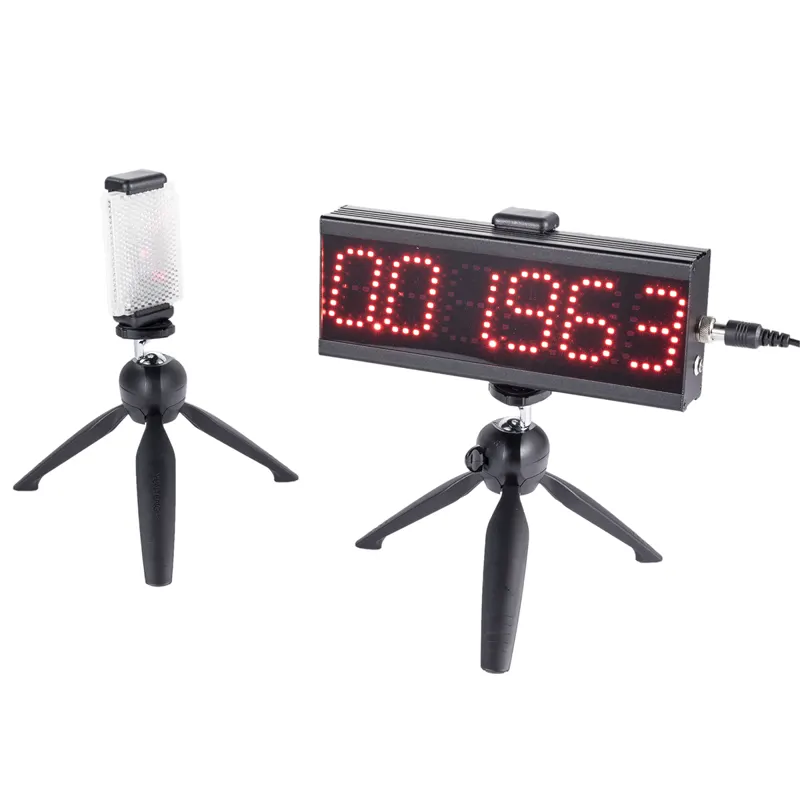
Tennis Court Speed Testing with Timing Gates
A tennis player rarely moves in one straight line for long, which makes test selection important. Linear speed, a planned turn and a racket-based court route measure different tasks. Keeping those tasks separate gives the coach a clearer record than one general “agility” score.
Pick a movement before placing equipment
Use a straight sprint when the question concerns acceleration. Use a fixed route when the staff wants to examine planned lateral movement or a turn. Reactive work adds a cue and decision, so it should have its own protocol and should not be hidden inside a pre-planned test.
A review of fitness testing in tennis describes field-based tests as useful for building player profiles when the test battery matches the sport and is repeated over time. That does not make every court drill a valid comparison. The route and scoring rule still need to be written.
Use court lines as references, not assumptions
Choose the exact edge or center of a line that defines each mark. Measure the route rather than relying on the court name alone, especially when portable courts, indoor markings or shared facilities are involved. Tape small station labels outside the running path so the same setup can be rebuilt.
Check the space past the finish and around each turn. A net post, bench, curtain or ball basket can reduce the area available for safe deceleration. Timing equipment and spare cases should sit beyond the athlete's reach during a full-speed attempt.
Separate three common test types
| Test type | Setup focus | Result label |
|---|---|---|
| Linear court sprint | Measured straight path, fixed stance and clear run-out. | Distance, start method, surface and racket condition. |
| Planned shuttle | Visible turn lines, required touch or foot rule and one finish gate. | Route sequence, number of turns and validity rule. |
| Lateral change of direction | Matched left and right marks with a stated body orientation. | Starting direction, racket hand and turn condition. |
The S-002 shuttle-run workflow explains how to keep turns and return passages consistent. For a single 180-degree turn, the 505 timing guide provides another documented format.
Decide whether the racket belongs in the protocol
Carrying a racket changes arm action, posture and how the player approaches a court movement. If the goal is a general physical baseline, the staff may choose a non-racket test. If the question is closer to a tennis movement, a racket condition may be appropriate.
Write the choice in the protocol name. A study of youth tennis players compared several sprint and change-of-direction tests and treated each route as a separate measure. The published tennis change-of-direction study is a useful example of why route, starting condition and turning direction need their own labels.
Check both directions without blending them
When the route can begin toward either side, record the starting direction for every attempt. Do not average left-first and right-first times before inspecting them separately. A difference may come from the route, footwork instruction, familiarity or a setup error.
Use the same turn marker and observer position on both sides. If a player misses the required line or turns early, mark the attempt invalid. The operator should make that decision during the trial, not after seeing the time.
Keep the beam away from loose balls
Clear the testing court before each block. A rolling ball, waiting player or swinging racket can trigger a poorly protected beam. Walk through the start and finish, then complete one reduced-speed rehearsal to check the route and display response.
The timing-gate alignment guide covers beam positioning. If the route uses several checkpoints, review the multi-point layout guide before assigning channel names.
Save the court conditions with every block
Record player ID, test name, starting direction, racket condition, attempt, time, validity and notes. At session level, add court surface, footwear rule, warm-up, recovery and gate positions. Keep the original attempt rows even when the report highlights a best time.
For a group session, the team testing-day workflow helps staff manage athlete order and lane roles. The athlete data guide provides a simple structure for comparing later sessions without losing the setup.
Court note: a forehand-side route and a backhand-side route can look symmetrical on paper while asking different movement questions. Label both.
Questions about tennis speed testing
Can a normal rally drill be timed?
It can be observed, but a variable rally is difficult to compare as a fixed speed test. Use a defined route and cue when repeatability is the goal.
Should the player touch the turn line?
Choose a clear foot, hand or racket rule before testing. Apply the same rule to every athlete and have an observer watch the turn.
What if the court changes?
Record the new surface and remeasure the route. Start a separate comparison series if the conditions cannot be matched to earlier tests.