01TIMER.COM / Timing system guides / rugby sprint testing
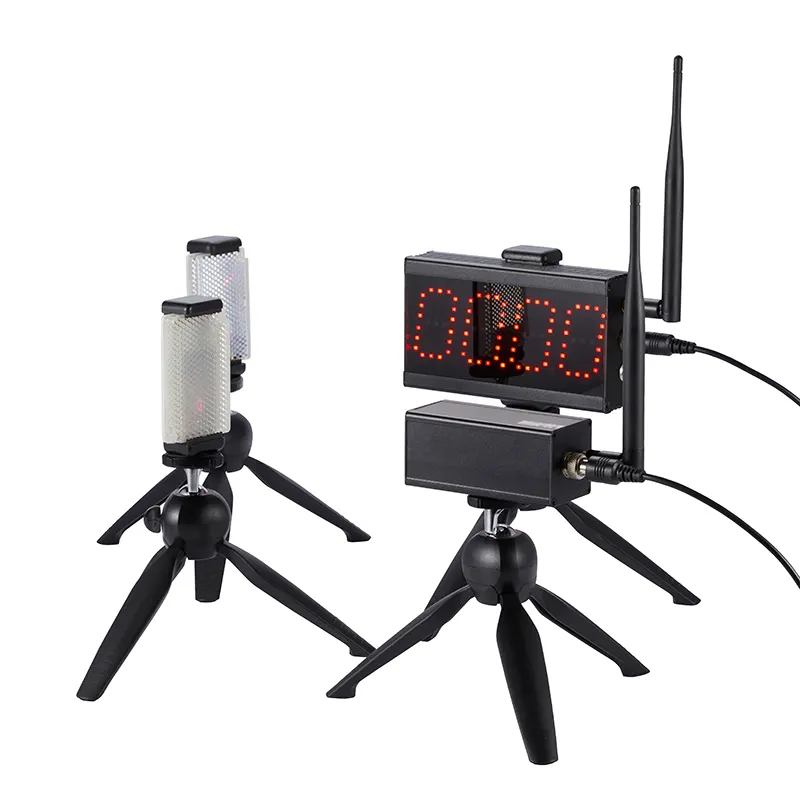
Rugby Sprint Testing with Timing Gates
Rugby players accelerate from many positions during training and matches. A testing session cannot reproduce every one of them, so the staff should select a small number of repeatable movements and state exactly what each time includes.
Separate linear speed from rugby-specific tasks
A straight sprint from a fixed stance provides a clean baseline. A ball carry, change of direction or effort after contact adds another skill or load. Those variations may matter to coaches, but the results belong under different protocol names.
Start with the simplest test that answers the question. Add a rugby-specific condition only when the staff can keep its equipment, movement rules and validity decisions consistent across the squad.
Lay out the lane before setting the gates
Measure the route from a permanent field reference when possible. Mark the athlete's start position, each timing point and the end of the run-out. Put cases, tripods and spare equipment outside the running channel, and keep another drill from sharing the finish area.
A carry case helps equipment move between venues, but it does not preserve the geometry. Save a lane diagram or setup photograph with measurements. The B-01 portable kit field workflow shows how to inventory, deploy and repack a field system without losing station labels.
Use split times for a stated reason
| Test format | Useful record | Comparison warning |
|---|---|---|
| Short acceleration | Opening time from a fixed stance to a measured gate. | A start offset or stance change can alter the result. |
| Longer linear sprint | Total time plus named intermediate splits when available. | Later sections should not be mixed with a flying test. |
| Ball-carry sprint | Time, carry side and ball-handling instruction. | Keep it separate from an unrestricted sprint. |
| Post-task sprint | Time plus the load or movement completed beforehand. | Recovery and task completion become part of the protocol. |
Research involving amateur rugby players compared maximum-speed estimates from timing-gate splits with radar measurements. The authors reported good within-session reliability but also found that some estimates differed by method. The published rugby timing-gate study supports a practical rule: keep the measurement method unchanged when tracking a player over time.
Define the start in plain language
Record the stance, front foot, distance behind the first beam and whether the player starts alone or reacts to a command. Check for rocking, an early hand movement or equipment crossing the beam. Use the same invalid-start rule for every player in the block.
If the test begins on an external signal, the result includes the response to that signal. The reaction-time guide explains why this should remain separate from a movement-triggered sprint.
Control the field around the athlete
Rugby sessions often have several groups working at once. Assign one person to control the timing lane and another to manage the roster if numbers are large. Players waiting for a trial should stand away from every beam, not beside the receiver or finish gate.
Check the surface and weather at the start of each block. If rain, field traffic or a moved marker changes the lane, stop and record the change before continuing. The outdoor conditions guide provides fields for these notes.
Keep recovery and attempt order visible
Choose a recovery rule that fits the purpose and apply it throughout the block. Record the actual order of attempts, because a late athlete or equipment pause can change recovery time. Avoid turning a maximal sprint test into a fatigue test by rushing the queue.
For a repeated-effort question, use a protocol designed for that purpose. The repeated sprint timing guide covers sequence, recovery and trial-level records without mixing them into a single-effort ranking.
Review player context before ranking
Store athlete ID, position group, protocol, attempt, split values, total time, validity and notes. Position can help a coach filter results, but it does not replace an individual baseline. Compare a player with previous tests only after checking surface, start and timing method.
The athlete data workflow explains how to keep the raw row before producing a summary. For large squads, the team testing-day workflow adds lane roles and handoff rules.
Squad note: record the method beside the time. A number cannot explain whether it came from a free sprint, a ball carry or a post-task effort.
Questions about rugby sprint timing
Should players wear match boots?
Use the footwear rule selected by the staff and record it. Do not compare boots, trainers and different surfaces as if the test conditions were identical.
Can two lanes run together?
Yes, when both lanes have matched measurements, independent channels and separate run-out space. The dual-track timing guide covers those checks.
What should happen after a false trigger?
Mark the attempt invalid, clear the lane and repeat it according to the written recovery rule. Keep the original row and reason.