First decide what the test is meant to measure
Reactive badminton agility combines movement with a decision. If an athlete memorizes a route before the clock starts, the test measures planned change-of-direction speed. That is still useful, but it is a different question from how quickly the player reads a cue and moves to the selected corner.
The 2016 Badcamp study by Loureiro and de Freitas used six targets around a 5.6 by 4.2 m test area. A light panel indicated the next target. In 43 badminton players aged 17 to 32, the authors reported an intraclass correlation coefficient (ICC) of 0.93 and a correlation of 0.83 with a shuttle-run agility test. Those figures describe that protocol and sample. They are not a universal reliability guarantee for any six-cone drill.
A later specificity study compared badminton players with tennis, team-sport and track-and-field athletes. Badminton players were faster on Badcamp, while the generic shuttle-run test did not separate the open-skill groups in the same way. The authors' point was about test specificity: the route and the cue can change what a score represents.
What recent six-target research adds
Ye and colleagues' 2026 badminton reactive-agility test, B-RAT, used six shuttlecock targets in a 6.2 by 5.18 m area and randomized visual signals. Athletes moved from the center, touched the target, returned to the signal point and completed six directions. The study reported ICC 0.90 and a coefficient of variation (CV) of 5.82% in the 58 athletes who completed two sessions a week apart.
B-RAT also logged segment and total times, and specified which hand touched each target. Those details matter. If a coach changes the cue source, sequence, target size or touch rule, the new result may be useful for that squad, but it is no longer the same published protocol.
Place timing points around recorded events
Write the event sequence before placing equipment. For a simple total-time drill, define one start event and one finish event. For segment data, decide which movement transitions need their own time and whether the hardware records each event directly. A finish beam alone cannot tell you whether six target touches were correct.
For a reactive protocol, the light or audio cue must be part of the timing record if reaction time is an outcome. If the clock starts when a player first breaks a beam after the cue, the reported value includes the response plus the movement to that beam. It is not a pure reaction-time measure. State the exact event in the result sheet.
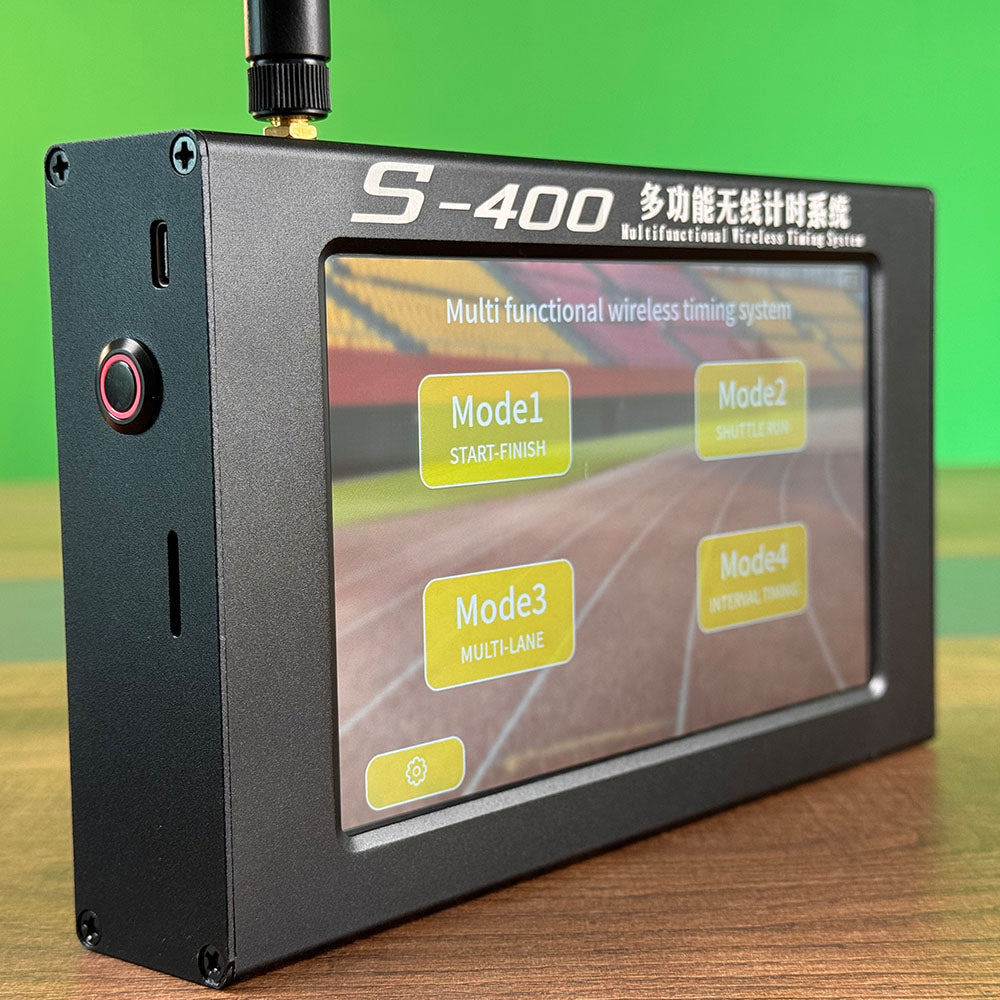
The published 01TIMER pages describe multi-point and multifunction running systems, but do not claim a badminton-specific random cue or target-touch validation mode. The S-007 product information and multi-point layout guide are useful for understanding timing points. Confirm the exact signal and split requirements before assigning a product to a reactive test.
Keep the six-point setup repeatable
| Record | Keep fixed between sessions | Why it changes the score |
|---|---|---|
| Target geometry | Measure the same rectangle and center position | Longer approaches add travel time and braking distance |
| Cue order | Use the same randomization rules, not necessarily the same sequence | Predictable order adds anticipation |
| Touch rule | Name the target, body part or racquet-hand requirement | A missed touch can make a fast time invalid |
| Start and finish | Specify readiness, cue onset and final return event | Different trigger points measure different phases |
| Conditions | Surface, shoes, warm-up and rest between trials | These affect traction, fatigue and movement strategy |
Run one familiarization before collecting a baseline. Keep a note of the sequence and mark every invalid attempt instead of deleting it silently. The athlete testing data workflow and CSV roster guide show how to retain the conditions beside the time.
Report movement time separately from the cue
If your equipment records only elapsed time from the first movement to the finish, label it total test time. Do not call it reaction time. If cue-to-first-movement latency is captured separately, retain both that value and the movement segments; a single total can conceal where an athlete gained or lost time.
A simple planned route can still help with footwork practice. Just name it accurately and do not compare it with a reactive-agility norm from a different apparatus. For beam placement basics, see the alignment and beam-height guide. The reaction-time guide explains why the start event needs a clear definition; the 505 setup guide covers a fixed-route change-of-direction test.
When a test changes direction on an external cue, the cue device and its event log belong in the method description. Gates provide a timestamp for the crossing they see. They do not turn a planned route into a reactive one.
Questions about badminton agility timing
Can I use an ordinary timing gate for a six-corner drill?
Yes, if the question is limited to the beam crossings it records. A simple gate does not verify every target touch or random direction cue. Have an observer record those events, or use a system designed to capture them.
Should beginners use the full court?
Choose and record a layout that fits the athletes and session. The research tests used defined areas smaller than a full badminton court. Changing the dimensions creates a different protocol, so do not compare its raw time directly with the published test.
What should be reported?
Include target layout, cue method, start and stop events, touch rule, invalid-trial criteria, number of attempts and whether the score is total time or includes a reaction component.
Research and method sources
- Loureiro Jr. and de Freitas (2016), Development of an Agility Test for Badminton Players, International Journal of Sports Physiology and Performance.
- Loureiro Jr. and de Freitas (2017), Assessment of Specificity of the Badcamp Agility Test.
- Ye et al. (2026), Reliability, validity, and feasibility of a method for assessing sport-specific reactive agility in badminton players, PeerJ.