How to Time a Field Hockey Repeated Sprint Test
A player asked to accelerate, brake, turn and go again needs a different test from one measured for straight-line pace. Choose the route and calculation before moving the first timing stand.
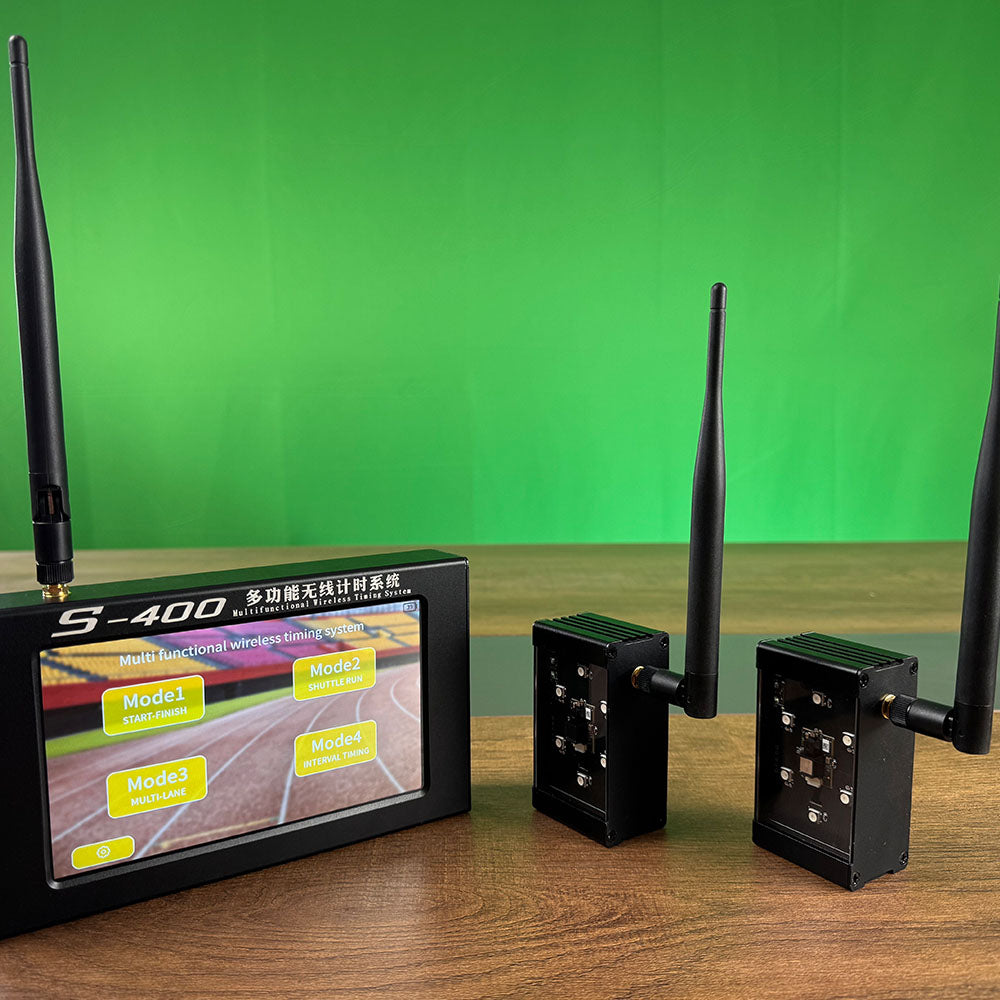
Use a shuttle when you want the test to include hard braking and a change of direction; use a linear sprint when the question is straight-line speed. In either case, keep the course, start cycle, instructions and score calculation fixed. A timing gate records a crossing, not whether a player met the turn rule.
Two published tests, two different questions
A 2022 study tested 28 international players, split evenly between women and men, with six 40 m shuttles: 20 m out, a 180-degree turn, then 20 m back. The sprints followed a 30-second cycle on a synthetic track. Players had to place a foot on the 20 m line, and staff visually checked that turn. The researchers reported the sum of six times as a reliable measure; the performance-decrement calculation was much less consistent in that sample. The total was associated with 40 m sprint performance, but not with the YoYo intermittent recovery score. A shuttle score should not be presented as a complete measure of match endurance.
A separate 2026 study used six maximal 30 m straight sprints with 30 seconds of active recovery in 14 elite female players. It explored relationships between sprint mechanics and GPS-derived match activity. That is not simply a shorter version of the shuttle test: it removes the turn and changes the recovery instruction. Use one protocol consistently rather than combining results from both studies.
Write the test card before setting up
Give every player the same course drawing and one-sentence instruction. Include the starting position, number of efforts, interval rule, turn-line action, invalid-trial rule and result to be reported. If the protocol is adapted for a school or club, label it as an adaptation. A familiar drill is not automatically equivalent to a published test.
| Record | Fix before the first effort | Why it matters |
|---|---|---|
| Route | Linear distance or out-and-back distances, turn angle and line rule | Distance and turning change the physical task. |
| Start cycle | Fixed departure times or fixed recovery after each finish | These create different work-to-rest patterns. |
| Timing point | Start beam, return beam or each split point | A recorded time only represents the crossings that were actually measured. |
| Score | Raw efforts plus the selected summary calculation | Preserves enough information to audit the final number. |
Place the timing line around the athlete path
Measure from the intended beam plane, not from the tripod feet. Mark the athlete's start position and keep it the same across sessions. For a shuttle, put the turn mark where the player can approach, plant and leave without striking a sensor, stand or waiting athlete. Assign an observer to the far line. That person calls a missed line or incorrect turn even when the timer returns a plausible number.
The S-002 product page describes same-point turn-back timing for shuttle runs. It may be relevant to a return-to-start test, but it does not establish that a particular international hockey protocol is supported unchanged. Check the selected mode, distance and package against the S-002 session setup guide and the current instructions. A multi-point or split question may call for a different arrangement.
Before scored trials, rehearse one walk-through and one controlled sprint. The beam alignment guide covers crossing checks; the outdoor conditions notes help when wind, glare, surface or moving people affect a temporary setup.
Choose a score that is stable enough to interpret
Keep every attempt in the record. The 2022 field hockey study found that the sum of six shuttle times was more dependable than its performance-decrement score, whose variation was high in both groups. That finding is specific to the protocol and sample, but it is a useful warning: a derived fatigue percentage can move around even when the raw trials look similar. If fatigue resistance is the coaching question, preserve the full sequence and report the method, not only a single percentage.
For a repeated-sprint series, list the athlete ID, session date, surface, course version, start rule, interval, each raw time, invalid attempts and the chosen summary. The repeated sprint timing guide and shuttle comparison guide give broader recording checks. Use the athlete testing workflow and CSV export guide to keep later comparisons tied to the correct athlete and protocol.
Keep the interpretation narrow
Repeated shuttle time combines sprinting, braking and turning; a straight sprint test isolates a different route. Neither number alone explains every high-intensity movement in a match. The 2022 sample was international-level players and the 2026 sample was elite women, so do not transfer their exact values or thresholds to a different team as norms. Use the studies to understand test design, then build a local baseline with the same surface, equipment, warm-up and instructions.
For a new product layout, compare course shape and timing-point needs in the S-002 and S-005 course guide and the system selection guide. Confirm model compatibility and operating mode with the setup or quote team when the published product description does not answer the question.
Research used
- Goods PSR et al. (2022), repeated shuttle sprint testing in international field hockey players.
- Rivera C et al. (2026), linear repeated-sprint mechanics and match activity in elite female field hockey.
Common questions
Does a 30-second cycle mean 30 seconds of rest?
Not necessarily. The 2022 study described efforts on a 30-second time cycle. A fixed start-to-start cycle and a fixed recovery period after the finish are different instructions, so write the one your test actually uses.
Should the turn line be judged by the timing system?
Only if the selected system and setup have a validated way to detect the required action. In the cited shuttle study, staff visually confirmed the foot reached the line.
Can I compare these results with a straight 30 m test?
No. A shuttle includes a turn and return while the straight test does not. Keep them in separate result series and label each test clearly.