What the futsal studies actually tested
In a 2022 study, 15 trained male futsal players completed a repeated curve sprint test (RCST), a running-based anaerobic sprint test (RAST) and a Wingate test across three weeks. The RCST used seven 30 m curve sprints with a change of direction near the midpoint and 25 seconds of recovery between efforts. Parnow, Amani-Shalamzari and Mohr reported correlations between RCST peak and average power and the corresponding Wingate and RAST results. The sample was small, so the result supports that protocol as a field option, not a universal score table.
A separate 2018 study of 20 elite futsal players used seven straight 30 m sprints with 20 seconds of active recovery. Photocells sat at 0, 5 and 30 m. The study focused on muscle contractile properties, but its layout shows why the first 5 m and the full sprint should be recorded as separate observations. The published protocol found no significant change among the seven 5 m split times, while the 30 m times increased from the third sprint onward.
Map the course before placing the gates
Start with the source protocol and draw the running path. Mark the start, finish and any split event on a course sketch. For a curve route, record which way the athlete turns and reproduce the same shape each session. A measured 30 m path is not necessarily a 30 m straight line. Do not substitute a straight lane and keep the curve-test label.
Position timing planes where they match the events in the test sheet. If the protocol reports total time only, identify start and finish. If it also reports an early split, mark that distance along the path and state whether the value is cumulative or segment time. In a curve, a gate is only useful if the athlete crosses its plane at the intended point and can do so without cutting the route.
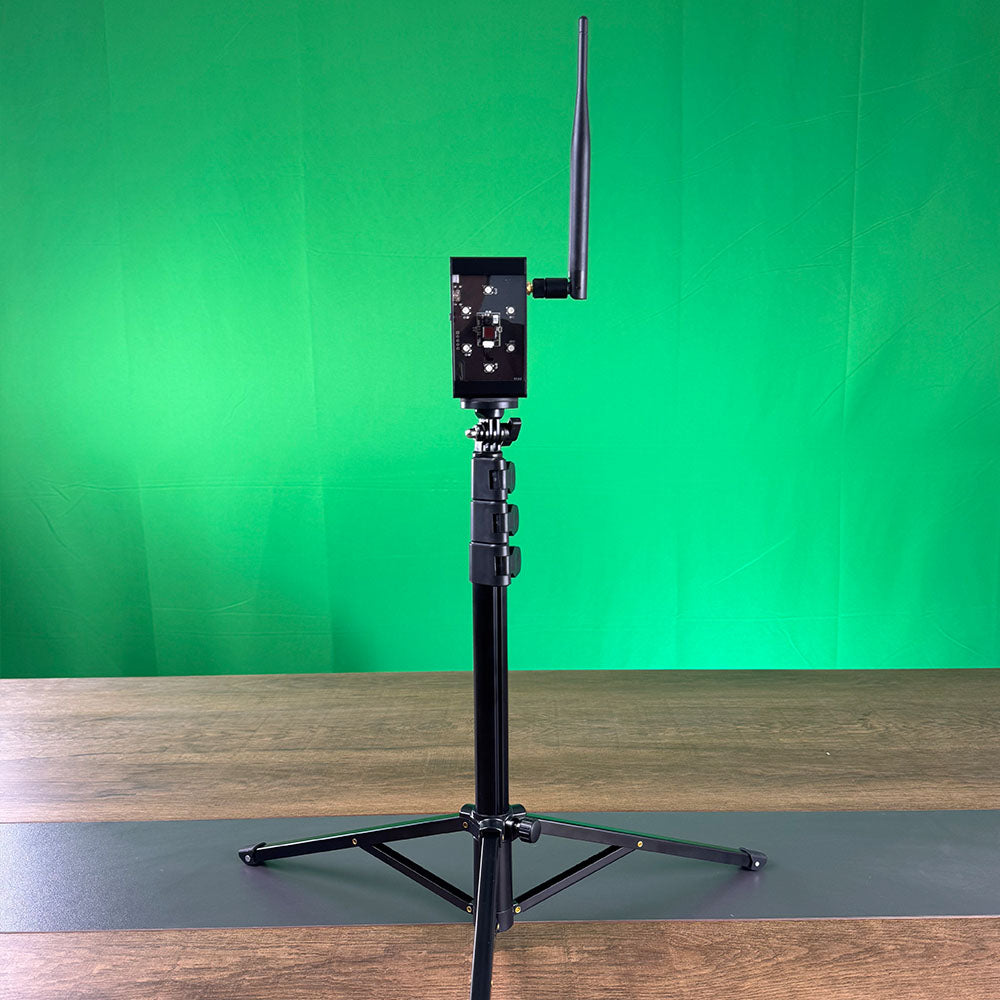
Keep the lane clear of adjacent runners and equipment. Walk one full course at low speed before maximal trials, check that every station records once, and verify the athlete's route with an observer. Do not place a gate, tripod or cable where a player may clip it while leaning into a turn. The beam alignment guide covers the timing plane; the S-007 multi-point layout guide is a reference for naming and checking multiple timing points. Confirm the selected model supports your exact start, split and finish events.
Keep a straight sprint and curve sprint in different columns
The 2018 and 2022 futsal papers did not use identical tests. One measured repeated straight runs with 20 seconds of active recovery; the other measured repeated curve runs with 25 seconds between efforts. Route, recovery and scoring all changed. If an athlete posts a faster total in one format, that does not establish a gain in the other.
A study of 40 experienced soccer players also found that a 17 m curve sprint and a 17 m linear sprint were not interchangeable measures. The tests had only about 35% shared variance, and their curve-sprint coefficients of variation were 0.87% and 1.15% by direction. Those figures apply to that soccer protocol, not to futsal norms, but they support keeping curve and straight results separate. Filter and colleagues' curve sprint study provides the method details.
| Result field | What to save | Why it matters |
|---|---|---|
| Effort number | Raw time for every valid sprint | Shows when performance changes during the set |
| Route | Straight or curve, direction and measured path | Prevents unlike courses being grouped together |
| Recovery | Exact interval and active or passive rule | Changes the repeated-effort demand |
| Split | Distance, cumulative or segment label | Keeps acceleration data interpretable |
| Conditions | Surface, footwear, warm-up and test version | Provides context for later comparisons |
Be careful with fatigue-decrement percentages
It is tempting to reduce a set of sprint times to one fatigue index. The calculation can look precise while the underlying measure is noisy. A systematic review of repeated sprint tests found total work and best sprint performance had strong reliability across the reviewed protocols, but fatigue indexes had weaker absolute and relative reliability. Lopes-Silva and colleagues' review also found that protocols and scoring methods varied substantially between studies.
Keep the raw trial list. If you report a total time, mean, best effort or decrement percentage, name the calculation and keep it unchanged across sessions. Do not infer that a small movement in a fatigue percentage is meaningful unless you know the expected variation for your own test and group. The repeated sprint timing guide covers athlete order and recovery records; the CSV export workflow helps preserve each effort instead of only a summary.
Choose the question before choosing the route
Use a straight repeated sprint when you want a straight-line repeated-effort profile. Use a curve protocol when its turning path is part of the test question. Then state the exact distance, direction, timing events, recovery period and score in the session plan. That small amount of protocol detail prevents a straight sprint, a shuttle and a curve sprint from collapsing into one generic label: “futsal fitness.”
For field setup planning, compare the S-400 configurable timing plan with the same-point shuttle workflow only after drawing the route. The hardware should follow the measurement plan, not dictate it.
Futsal repeated sprint questions
Is the 2022 curve test a standard futsal test?
It is a published research protocol, not a governing-body standard. The authors studied 15 trained male futsal players and compared the test with two laboratory or field anaerobic tests.
Can the curve test use a single start and finish gate?
Only if those are the events you intend to report and the course supports safe, repeatable crossings. A split or intermediate event needs its own defined point and a compatible timing mode.
Should I report best time or total time?
Choose the score that answers your coaching question, retain all valid efforts and label the calculation. The reliability review cautions against treating a fatigue index as automatically dependable.
Research sources
- Parnow, Amani-Shalamzari and Mohr (2022), The Repeated Curve Sprint Test Appears to be an Appropriate Tool for Estimating Anaerobic Fitness in Young Trained Male Futsal Players.
- Filter et al. (2019), New Curve Sprint Test for Soccer Players: Reliability and Relationship with Linear Sprint.
- Effect of a Repeated Sprint Ability Test on the Muscle Contractile Properties in Elite Futsal Players (2018), Scientific Reports.
- Lopes-Silva et al. (2019), Measurement Properties and Feasibility of Repeated Sprint Ability Test: A Systematic Review.